Five Famous French Impressionists
In art history, Impressionism is regarded as one of the epochs with the greatest innovations. Essentially, the impressionists attempted something impossible: they no longer understood their paintings as a mirror of reality but sought to convey an atmosphere. This revolutionary approach for its time would go on to transform painting profoundly.
Impressionism originated in Paris around the mid-19th century. A young generation of artists no longer recognised themselves in the style of painting taught at academies and expected by museums and galleries. Above all, they were very sceptical of Realism. They no longer wanted to depict subjects in a supposedly "correct" or objective way but aimed to bring their subjective perception of the world onto the canvas. To achieve this, they focused on light and atmosphere and on how these could be expressed using painterly techniques.
Among these young artists were impressionists who are famous today, such as
- Claude Monet,
- Pierre-Auguste Renoir,
- Edgar Degas,
- Camille Pissarro and
- Édouard Manet.
However, the avant-garde faced rejection from most art critics. Their works were described as "sloppy", "unfinished", or the work of "madmen", among other things. They were also consistently excluded from established art exhibitions. Yet the impressionists did not allow themselves to be deterred from their goals. From 1873 onwards, they organised themselves into the "Société anonyme des artistes peintres, sculpteurs et graveurs etc." and held their own exhibitions.
Édouard Manet – The Individualist Among French Impressionists

French Impressionism owes much to him – yet he also distanced himself from it: Édouard Manet (1832–1883) remained an artistic loner throughout his career but nevertheless became one of the most important painters of the 19th century.
Role Model for a New Generation of Artists
His progressive painting style attracted little attention from the art establishment. The young avant-garde artists, however, celebrated him as a great role model. Manet maintained contacts with many artists now known as famous impressionists, including:
- Paul Cézanne,
- Claude Monet,
- Camille Pissarro,
- Edgar Degas,
- Pierre-Auguste Renoir.
He influenced many of these painters, while also drawing inspiration from this circle of artists.
His early work was still heavily influenced by Realism, but gradually he broke free from the constraints of traditional painting. He disregarded many academic conventions and developed his own individual vision of how his paintings should be composed.
Manet’s Painting Techniques and Perspectives
In many ways, he was far ahead of his time. As early as the 1860s, he painted with short, clearly visible brushstrokes. This technique reduced the level of detail in his subjects and diminished their realistic character.
He also reinterpreted perspective, giving the objects in his pictures little spatial depth, resulting in a very flat and immediate visual effect. Additionally, he did not always adhere to the true proportions of objects relative to one another.
Manet’s paintings also stood out to his contemporaries because they often appeared very dim. Contrary to the trend of his time, he used a very muted colour palette, giving black and grey tones unusual prominence.
Variety of Motifs – Often Provocative
His portfolio of motifs covered nearly all genres:
- Portraits of celebrities, family and friends,
- Genre scenes at the hunt, on the beach, in the garden or at a dance,
- Female nudes,
- Landscapes,
- Seascapes and
- Still lifes of flowers, a lemon or a bunch of asparagus.
He interpreted many of the traditional genres in a very progressive way, sometimes causing scandal in the process:
- In "The Luncheon on the Grass", he depicted a nude, very self-confident woman in the company of two clothed men.
- His portrayal of "Olympia" also provoked controversy. Critics remarked that her pale skin made her look like a corpse and claimed the painting lacked any understanding of art.
Today, however, these works, along with many others by Manet, are considered milestones of 19th-century art and precursors of modernism. Many of his innovations were adopted by French impressionists in the following years.
Claude Monet – French Landscape Painter and Figurehead of Impressionism

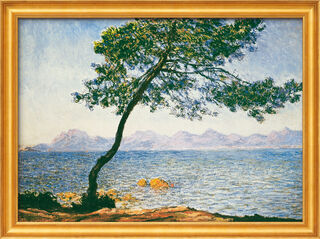
Claude Monet – this name is almost synonymous with French impressionist painting. Many of his works became icons of the epoch, such as the Water Lilies series, scenes from his garden at Giverny, and, of course, "Impression, Sunrise", probably his most famous painting.
Atmosphere Rather Than Representation
Monet (1840–1926) had little interest in the academic style, which in the mid-19th century was still strongly tied to Realism. However, Monet felt that the pure representation of the world was not enough. He defined his artistic goal as:
"The task of the artist is to represent what lies between the object and the artist, namely the beauty of the atmosphere."
He accordingly devised an innovative form of composition, drawing on influences from fellow artists such as Pierre-Auguste Renoir, Alfred Sisley, and Camille Pissarro, as well as English painters like John Constable and William Turner.
Monet developed several techniques now considered typical of Impressionism:
- To capture the atmosphere of a moment in a picture, he focused on the light of the scene and its effects on colour, shadow, contrast, and contours.
- He painted only what he perceived in the immediate situation. Whether this impression matched reality was secondary.
- He reduced the details of the objects in his pictures and softened their outlines.
- He applied oil paints to the canvas with short brushstrokes, imitating various light effects.
These series include the Rouen Cathedral, haystacks in the fields, and his garden at Giverny, among others. There is hardly a more impressive way to capture how the character of a landscape can change with changing light.
World-Famous Paintings
Monet’s oeuvre includes many globally renowned paintings. Some stand out particularly.
First and foremost is certainly "Impression, Sunrise" from 1872. The painting shows the harbour of Le Havre in France in the early morning mist. Monet subordinated everything to the atmosphere of the scene. Almost the entire harbour is bathed in pastel colours between grey and blue, the sun shines in the sky as a simple orange dot, and only the silhouettes of ships and docks are visible. Here, Monet perfectly combined all the design principles of French Impressionism.
Monet’s Water Lilies are also indisputable highlights. From around 1890, he painted numerous views of the pond in his Giverny garden. The water lilies varying colours, reflections, and play of light inspired him to create countless works.
Camille Pissarro – Key Figure of French Impressionism

His name may not be as familiar as Monet, Manet, or Renoir, yet the French painter Camille Pissarro (1830–1903) made significant contributions to the development of French Impressionism.
He experimented extensively with colours, motifs, and application techniques, constantly seeking new forms of painterly expression. He was also in regular exchange with many other progressive artists of his time.
Pissarro’s Break with Tradition
From his early twenties onwards, Pissarro showed great interest in the innovative artists of his time. Instead of pursuing traditional training at the École des Beaux-Arts, he studied under Camille Corot, among others.
Corot had already diverged from the conservative academic style by the mid-19th century, exploring new approaches to light and colour. Through Corot, Pissarro also encountered the "Barbizon School", now considered the "cradle of Impressionism".
At the free painting school "Académie Suisse", Pissarro met Claude Monet and Paul Cézanne. Over the following years, he built a large network of avant-garde artists, including Monet, Cézanne, Pierre-Auguste Renoir, Edgar Degas, and Paul Gauguin. Within this circle, the idea arose to organise independent exhibitions in protest against conservative art and exhibition policies.
What Did Pissarro Capture on Canvas?
Pissarro repeatedly varied his painting style throughout his career. He began painting at a time when realistic representation was in high demand. However, he quickly turned away from this and concentrated on how to capture the atmosphere of a moment, light, and subjective impressions. To achieve this, he reduced the details and worked with broader, shorter brushstrokes. He increasingly dissolved the sharp outlines of objects to give his paintings airiness, while also allowing the colours more prominence.
Like many French impressionists, Camille Pissarro devoted himself primarily to landscape painting, including:
- fields,
- meadows,
- forests,
- gardens,
- cultivated landscapes and
- street scenes.
In doing so, he succeeded in bringing a very idiosyncratic view of his environment to the canvas. Although the landscape was always in the foreground, he often included people in his motifs. For example, he painted:
- Farmers in the fields – "The Harvest", 1882
- City dwellers on busy streets – "Pont-Neuf", 1902
- Subtle human presence – "The Factory at Pontoise", 1873
At first glance, his works often appear purely as landscapes, but they are actually small studies of everyday life in rural and urban settings.
Like Monet, Pissarro painted some motifs multiple times under different times of day and weather conditions. Among the most famous are views from a hotel window overlooking "Boulevard Montmartre", capturing light, people, vehicles, and buildings in perfect harmony through spring to winter, day and night.
Pierre-Auguste Renoir – Innovation Meets Tradition

Pierre-Auguste Renoir (1841–1919) was an impressionist from the very beginning and an avant-garde figure of his time. Unlike many of his colleagues, he did not completely abandon older styles. Rather, he combined tradition and modernity, incorporating influences from Baroque/Rococo, the Renaissance, and ancient sculpture into his painting. This distinctive style made him one of the most important French impressionists.
Renoir’s Artistic Path
Renoir developed an interest in visual arts at an early age. He frequently visited the Louvre, studying works by the Old Masters, classical art, and contemporary painters.
At 13, he began an apprenticeship as a porcelain painter, followed by studies at the École des Beaux-Arts in Paris. At the same time, he also attended the studio of the Swiss painter Charles Gleyre, where Claude Monet and Alfred Sisley were among the students.
Influenced by his young peers, Renoir increasingly distanced himself from the academic, realism-based painting of the academies. Like his colleagues, he focused on capturing the light and atmosphere of the moment.
His progressive approach developed further within the "Société anonyme des artistes peintres, sculpteurs et graveurs etc." He also participated in the first two exhibitions organised by the impressionists.
Joy of Life as a Central Motif
Although Renoir often worked among his impressionist friends, he maintained a highly individual style. Unlike many colleagues, he did not aim for Realism. Instead, he sought to create cheerful, decorative paintings of idealised moments.
The scenes he depicted did not necessarily correspond to reality. Renoir therefore often staged his motifs. For example, he meticulously dressed the people he was to portray in selected clothing and accessories.
His choice of colours also contributed to the idealisation of his motifs. Using pastel colours and bold brushstrokes, he exaggerated his scenes into something sensual, almost dreamlike.
Renoir also chose motifs to match this. He often depicted the positive sides of life in his works:
- One of his most famous works, "Luncheon of the Boating Party" (1881), shwos such a scene. Here, young people sit together enjoying a summer afternoon in lively company.
- "Bal du Moulin de la Galette" (1876) depicts joyful people conversing or dancing in perfect weather. The perfectly rendered light effects of sun and shadow authentically convey the atmosphere of this day at a picnic restaurant.
But many other works by Renoir also depict everyday moments in which people are enjoying themselves, such as bathing, going to the theatre or dancing.
Renoir became famous for his portraits, particularly of women, emphasising beauty and elegance. This also applies to his nude paintings. He painted female bodies in a way that shows unmistakable parallels to Baroque and Rococo in their sensuality. Such a return to earlier epochs was a fundamental part of his art. "I am a man of the 18th century", he once wrote in a letter to Claude Monet.
Edgar Degas – The Realist Among Impressionists

Edgar Degas (1834–1917) was a key figure of the artistic avant-garde in the latter half of the 19th century. He moved in the circles of French impressionists but never claimed the label himself. He differed fundamentally in both style and artistic philosophy. Due to these differences, Degas ultimately ceased collaborating with the group and exhibited with them for the last time in 1886.
Why Degas Was Not a Typical Impressionist
Edgar Degas began his formal artistic training around the age of 20 at the École des Beaux-Arts in Paris, but soon left. From then on, he continued autodidactically, studying and copying works in Parisian museums. Initially, he devoted himself to history painting and exhibited in the conservative Paris Salon.
Through contact with contemporaries like Manet, Cézanne, and Renoir, he evolved his style. Degas was among the founders of the impressionist exhibitions from 1874, but his works had little in common with those of his contemporaries. He painted with much finer brushstrokes, clearly defining contours and details, while occasionally softening silhouettes for a blurred effect.
Degas also preferred a different working method to most Impressionists. Relying on spontaneity and inspiration arising from the situation contradicted his artistic concept. He also rejected plein air painting, which was very popular among the impressionists. Instead, his work was based on meticulous planning and controlled conditions.
For his paintings, he drew on existing drawings or his own sketches, or he painted from memory. During the painting process, he preferred closed rooms with artificial light and had his models remain in instructed positions in his studio, sometimes for hours.
Dance as a Recurring Theme
Degas's works primarily depicted motifs from contemporary life. In addition to scenes from horse racing, excursions, variety shows and social occasions, he painted moments from the everyday lives of ordinary people such as laundresses, farmers and an ironer, as in a painting from 1869.
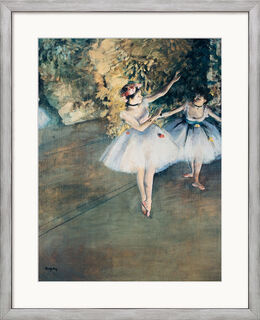
He was particularly fascinated by opera, dance, and ballet. One of his most famous works, "The Dance Class" from 1875, shows dancers with a teacher during instruction.
He also painted numerous variations of dancers and ballerinas warming up or practising, demonstrating his profound understanding of posture, movement, and a seamless blend of traditional and progressive techniques.
French Impressionism’s Lasting Impact
19th-century French Impressionism was a milestone in the evolution of painting. Its innovations in composition, technique, and philosophy were groundbreaking and continue to resonate today.
Above all, the rejection of realistic depiction and the reduction of detail influenced subsequent generations of artists. Impressionism paved the way for other key 19th- and 20th-century movements, including Cubism, Expressionism, and ultimately Abstraction.
The influence of Impressionism extends into contemporary art. Its basic idea of focusing on capturing the mood of a moment rather than object detail is evident in the work of many contemporary artists like Christoph Bouet, Anke Gruss, or Ben Kamili. Original works by French impressionists such as Monet, Manet, and Renoir remain popular highlights in exhibitions and auctions.
Selected works by the five famous French Impressionists