Epochs of Painting
Renaissance, Impressionism, abstract pictures or Pop Art – these and many other significant epochs of painting have had a decisive influence on art history. Over the past approximately 1,500 years, a fascinating diversity of styles has developed in painting – and to this day, motifs, techniques and artistic concepts continue to undergo constant change. Below, we present a brief chronological overview of the most important epochs of painting from the Middle Ages to the present day. The focus is on the essential characteristics of each epoch as well as typical examples of works.
Middle Ages
The stylistic epoch of medieval painting extended roughly from the 5th to the 15th century. During this phase, various stylistic movements in art developed, such as Romanticism and Gothic. In the Middle Ages, painting was still entirely shaped by the clergy and Christian doctrine. The Catholic Church had established itself in many countries of Europe. It furnished its churches and monasteries with numerous paintings, frescoes and sculptures and was therefore the most important patron of artworks.
- Important function: In the Middle Ages, painting had an important task. As only few people were able to read at that time, paintings served as a central means of communication for the Catholic Church. The clergy used images to spread the Christian religion and its values and to strengthen Catholics in their faith.
- Religious motifs: As an influential patron, the Catholic Church also frequently determined the motifs. The paintings largely depicted themes from the Bible. These included, for example, scenes from the life of Christ, depictions of Mary or Pietà representations.
- Stylised manner of painting: The manner in which pictorial subjects were depicted in the Middle Ages was not yet very realistic. The figures were usually painted in a very simplified and stereotypical way. They also often lacked individual characteristics.
Example of a Work: "Annunciation to Mary" by Konrad Witz
The German-Swiss painter Konrad Witz created his painting "Annunciation to Mary" around 1440. In this work, he shows Mary in a simple room learning of her pregnancy from an angel. Konrad Witz, however, already counted among the avant-garde of medieval painters. He strove for a depiction of the pictorial objects that was as true to reality as possible. In addition, he attempted to introduce spatial depth into his paintings.
Epochs of Painting: Renaissance
The epoch of the Renaissance began around the turn of the 14th to the 15th century and lasted approximately 200 years. The central characteristic of Renaissance paintings was a return to the aesthetics and style of Roman and Greek antiquity. Painting in this epoch differed from the Middle Ages primarily in terms of subject matter and modes of representation.
- Secular and religious motifs: Whereas biblical and religious themes and figures had predominantly been at the centre during the Middle Ages, secular motifs now also found their way into painting. Painters increasingly portrayed ordinary people, and the first images of animals were also created.
- Return to reality: The most important characteristic of Renaissance painting was its claim to depict pictorial subjects as faithfully to nature as possible. Artists focused on the correct rendering of the proportions of human beings and nature. The introduction of linear perspective also contributed to this. This form of pictorial composition enabled artists to simulate spatial depth in their paintings.
- Oil painting: During the Renaissance epoch, oil painting became increasingly popular. Oil paints opened up many new possibilities for painters. They were stronger and more luminous and allowed for finer gradations of colour. In addition, oil paints enabled the technique of "sfumato". With this manner of painting, artists did not work with sharp contrasts, but allowed contours to blur slightly through skilful soft shading.
Example of a Work: "Mona Lisa" by Leonardo da Vinci
Many significant works in art history were created during the Renaissance, for example Sandro Botticelli's "Birth of Venus", Albrecht Dürer's "Young Hare" or the frescoes of the Sistine Chapel by Michelangelo. The most famous work of the Renaissance, however, is likely Leonardo da Vinci's "Mona Lisa". Da Vinci painted Mona Lisa's facial features as well as the landscape in the background of the painting with astonishing realism. In addition, the painting is considered a prime example of the sfumato technique.
Baroque
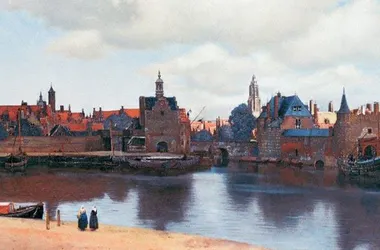
The Baroque followed directly on from the Renaissance and lasted approximately from the beginning of the 16th century until the middle of the 18th century. This epoch has become the epitome of opulent art. Numerous famous artists originated from the Baroque epoch, for example Michelangelo da Caravaggio, Jan Vermeer, Rembrandt van Rijn or Peter Paul Rubens. Baroque painting shared many similarities with that of the Renaissance. However, it developed further particularly with regard to subject matter and painting techniques.
- Diversity of motifs: Among the epochs of painting, the Baroque was the first in which artists addressed a wide variety of subjects in their works. Scenes from religion and mythology were still very popular. However, purely secular motifs such as genre scenes, landscapes, animals, still lifes and portraits became increasingly widespread.
- Realistic depiction: The Baroque style of painting was still clearly influenced by the Renaissance. Painters sought to depict their pictorial worlds as realistically as possible. They began to give the subjects a sculptural appearance and to create the illusion of spatial depth. In addition, they strove for a particularly dramatic and emotional depiction of their scenes.
- Use of light as a design element: A widely used technique to imbue scenes with atmosphere was the interplay of light and shadow ("chiaroscuro"). Deliberately placed spotlights or fading illumination created dynamism and defined the mood.
Example of a Work: "The Night Watch" by Rembrandt van Rijn
One of the most famous Baroque paintings is "The Night Watch" by Rembrandt van Rijn. The painting shows the assembly of an Amsterdam civic guard. Undoubtedly, the Dutch painter staged this scene rather than depicting it realistically. With a very distinctive use of light and strong contrasts of light and dark, he created an almost theatrical atmosphere.
Romanticism
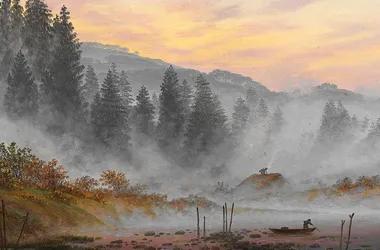
Romanticism refers to the epoch between the end of the 18th century and the middle of the 19th century. During this time, the humanities, art and literature broke away from the highly rational Classicism that immediately preceded Romanticism. In the philosophy of Romanticism, the individual with their emotions and inner world of thought was central. A spiritual connection with nature as well as the presence of the divine also once again played a role. Many of these aspects were also taken up by Romantic painters.
- Human beings and nature as motifs: As in previous epochs of painting, human beings continued to gain importance as a motif during Romanticism. Artists addressed the thoughts and emotions of the individual, sometimes concretely, sometimes symbolically. The second major group of motifs in Romantic painting was nature. Painters depicted landscapes in all their beauty. However, they also tended to glorify nature and present it more idyllically than it actually was.
- Emotions as a message: In Romanticism, painting became a mirror of the human soul. The motifs, especially landscapes, did not stand merely for themselves, but symbolised individual emotions such as melancholy, joy, fear or longing. Painters often relied on very dramatic or mystical pictorial worlds.
- Spiritual connotations: In Romantic paintings, the motifs were not only intended to be rendered as aesthetically as possible. The scenes always also contained allusions to transcendence, spirituality and religion. Particularly in epic landscape depictions, the idea of the existence of higher beings or parallel worlds was articulated.
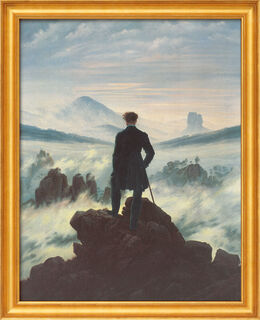
Example of a Work: "Wanderer Above the Sea of Fog" by Caspar David Friedrich
Caspar David Friedrich's masterpiece from 1818 is a particularly good example of Romantic art. It shows a man standing on a rock looking out over a turbulent sea of clouds. In this painting, Friedrich created a highly atmospheric landscape in which the human figure also plays a significant role. The scene can be interpreted in various ways, for example as a symbol of solitude, a melancholic retrospective view, a (metaphorical) gaze into the abyss or the attainment of a goal.
Epochs of Painting: Realism
Realism entered painting from the middle of the 19th century onwards. This style of painting was a reaction to preceding epochs of painting. These had hardly addressed the real living conditions of people and had often depicted the world in an idealised and embellished way. Realism, by contrast, was concerned with an authentic depiction of living conditions in the middle of the 19th century.
- Motifs from everyday life: Compared to other stylistic epochs of painting, Realism was characterised above all by its particular subject matter. Artists primarily addressed the living conditions of the ordinary population. In their paintings, they often showed everyday situations involving workers, farmers and the bourgeoisie. In addition to social life, landscapes also counted among the motifs. These paintings usually depicted local and rather unspectacular regions.
- No embellishment of reality: The pictures of Realism were intended to convey an authentic impression. For this reason, painters refrained from any form of idealisation, embellishment or dramatisation. Instead, artists adopted the role of neutral observers. Through their almost documentary character, realist painting also acquired a political and socially critical undertone.
- True-to-nature depiction: The aspiration of Realism was also reflected in the manner of painting. Painters aimed for a depiction of pictorial objects that was as close to reality and as detailed as possible. They neither used garish colours nor employed other exaggerated effects. Instead, they often worked with muted colours and adhered to the natural proportions of the subjects.
Example of a Work: "The Stone Breakers" by Gustave Courbet
The French painter Gustave Courbet (1819 – 1877) was a leading representative of Realism. In his painting "The Stone Breakers" from 1849, Courbet made two men engaged in hard labour the subject. It appears as if Courbet had observed the two workers secretly. Due to the realistic manner of painting, the scene appears very authentic and credible.
Impressionism
Impressionism developed in the second half of the 19th century. This epoch brought significant innovations to painting. Impressionist painters did not wish to depict the world realistically, but rather to capture the atmosphere of the moment in their works. To achieve this, they pursued entirely new approaches both in painting technique and in pictorial composition. The most well-known representatives of Impressionism include Claude Monet, Pierre-Auguste Renoir, Édouard Manet and Camille Pissarro.
- Atmosphere instead of perfection: In the preceding epochs of painting, the prevailing principle was that paintings should depict the world as precisely as possible. Impressionism was the first to break with this rule. Its painters set themselves the goal of transferring their individual perception of a moment onto the canvas. The depiction of lighting conditions played a particularly important role. Artists succeeded in reproducing the colour and intensity of light, which changed depending on the time of day and year.
- A revolutionary manner of painting: Impressionist painters also changed their painting style. In order to convey a subjective impression, they reduced the details of the pictorial objects, allowed contours to blur or painted only silhouettes. Painters also adapted their colour palette to the respective lighting situation. They frequently used light pastel tones, with which they were able to render subtle colour nuances.
- New techniques: Furthermore, artists changed the entire painting process. They no longer worked out pictorial details with the finest lines, but applied the paint using dots and broader strokes. In addition, they used more oil paint than usual, making the brushstroke clearly visible. Many Impressionist painters also set up their easels outdoors in order to transfer their impressions onto the canvas as quickly and unaltered as possible ("plein air painting").
Example of a Work: "Impression, Sunrise" by Claude Monet
No painting represents Impressionism as well as "Impression, Sunrise" by Claude Monet (1840 – 1926). The painting from 1872 shows the harbour of Le Havre in the morning. Monet was already working here with the characteristic stylistic devices of Impressionism. In the diffuse light of the still weak sun, only the silhouettes of the harbour facilities and the ships can be discerned. "Impression, Sunrise" was shown at the first exhibition of the Impressionist painters in 1874 and gave the entire epoch its name.
Modern Art
The art epoch of Modernism extended from the end of the 19th century to the middle of the 20th century. This phase was characterised by an unprecedented stylistic diversity. During this time, numerous progressive forms of expression developed, some of which radically broke with the traditional conventions of art. Several groundbreaking styles emerged, such as Cubism, Expressionism or Surrealism. The major names of this epoch include, among others, Pablo Picasso, Franz Marc, Paul Klee, Henri Matisse, Marc Chagall, René Magritte and Wassily Kandinsky.
- Progressive concept of art: Many styles of Modernism questioned the traditions of all previous epochs of painting. Their artists fundamentally redefined the task and function of painting. They no longer sought to depict the world perfectly. Instead, they presented their subjective perspectives in their works and articulated emotions and thoughts. Furthermore, they began to experiment with new forms of representation and to explore the possibilities of painting.
- Innovative composition: The artists of Modernism no longer felt bound by the traditional rules of painting. Particularly striking was the tendency towards stylised representation. Many painters reduced the details of the pictorial objects and worked with larger areas of colour. They also frequently abandoned the naturalistic assignment of colours to objects. Instead, they reassigned the colour palette, as for example Franz Marc did in "The Yellow Cow" (1911). They also interpreted the shapes of the objects and the pictorial perspective very freely.
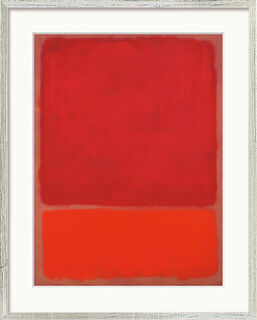
- Pioneers of abstraction: modernist painting was characterised, in comparison to all previous stylistic epochs of painting, by a progressive departure from representational depiction. Thus, the foundation for abstraction was also laid during this epoch. Many artists began to use exclusively free forms, structures and objects without any reference to existing objects in their works. Among the pioneers of abstraction were, among others, Wassily Kandinsky, Sophie Taeuber-Arp and El Lissitzky. Later, other important representatives followed, such as Jackson Pollock, Mark Rothko, Victor Vasarely and Antoni Tàpies.
Examples of Works: "Guernica", "Blue Horse I" and "Composition"
The great diversity of styles is reflected in numerous significant paintings that were created during Modernism. One of the most important works of this phase is Piet Mondrian's "Composition with Red, Yellow, Blue and Black" from 1921. With his visual language of planes and lines, Mondrian became a pioneer of abstraction. The German Expressionist Franz Marc painted the painting "Blue Horse I" in 1911. Since then, it has stood as a symbol of the influential artists' association "Der blaue Reiter". In 1937, Pablo Picasso created one of the most famous works of the 20th century with "Guernica". The monumental painting was to become an icon of the peace movement and political art.
Stylistic Epoch of Contemporary Painting
Contemporary art is generally understood to refer to art from the second half of the 20th century to the present day. The term does not stand for a specific stylistic epoch, but merely for the time span of the last approximately 80 years. Characteristic of this phase is the pluralism of styles and techniques. Numerous artists of contemporary art have achieved significant success, for example Andy Warhol, Gerhard Richter, Damien Hirst, Roy Lichtenstein, Alex Katz or Banksy.
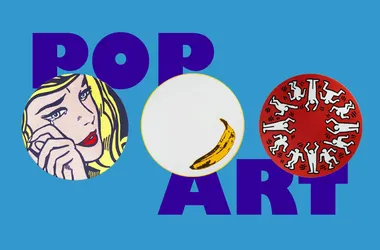
- Tradition and innovation: The diversity of styles that had already emerged in Modernism continued in contemporary painting. Many epochs from the first half of the 20th century, such as Expressionism, Surrealism and abstraction, are still relevant today. In the second half of the 20th century, further styles such as Pop Art, Abstract Expressionism or Urban Art were added.
- Modern techniques: Technological progress does not stop at painting either. Computer graphics, digital image editing and Artificial Intelligence have found their way into the work of many painters. Today, these new techniques stand on an equal footing alongside classical painting with oil, watercolour or acrylic paints.
- Mix of styles: Since the middle of the 20th century, it has also been observed that artists often do not see themselves as committed to only one specific epoch or technique. Instead, they often work with different styles and techniques simultaneously or combine them into a new form of artistic expression. For example, the work of Gerhard Richter includes both abstract and representational works as well as mixed techniques such as overpainted photographs.
Example of a Work: "Marilyn" by Andy Warhol
From the 1960s onwards, Pop Art brought a breath of fresh air to painting once again – both in terms of artistic concept and visual language. Pop Art artists elevated everyday objects and media content to motifs, worked with a strongly stylised, cool visual language and established new techniques in art such as screen printing. The American artist Andy Warhol represents this epoch like no other. Among his most famous works are his portraits of Marilyn Monroe. With several works in a mixed technique of acrylic paint, screen printing and ink, he paid tribute to the life of the world-famous film diva.
Selected works from the different epochs