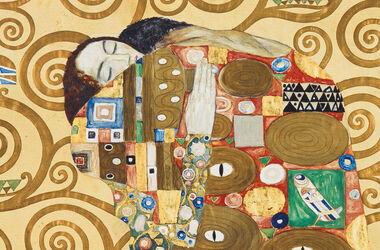
Expressionism: A Painting Full of Power and Emotion
Expressionism has shaped modern art like a few other styles. Its artists developed a fundamentally new understanding of the purpose of art and image composition. They aimed to convey their feelings, perceptions and moods in their paintings and sought new artistic forms of expression for that purpose.
The characteristic features of Expressionism include the reduction of objects to basic forms and their depiction in vibrant colours. At the same time, this artistic movement marked the definitive departure from the representational function of painting, paving the way for abstraction. Important representatives of Expressionism were Franz Marc, August Macke, Karl Schmidt-Rottluff, Gabriele Münter, Wassily Kandinsky, Emil Nolde and Ernst Ludwig Kirchner. The ground-breaking innovations of Expressionism continued to have an impact throughout many periods of the 20th century.
Expressionism Should Reflect the State of the Soul
The significant achievement of the Expressionist artists was their development of a fundamentally new philosophy of painting. According to their viewpoint, painting should no longer serve the purpose of capturing and depicting reality as objectively as possible in a naturalistic manner. Instead, it should reflect the subjective perspectives, emotions, and perceptions of the painters.
The artists thus made the paintings their tools to express states of mind such as sadness, joy, pain, fear, or even concrete experiences as authentically and as directly as possible. Rather than copying the objects, they turned them into vehicles for their feelings and views. Since reality could no longer serve as a standard for a "correct" representation of the objects according to traditional painting, any technique that helped articulate individual emotions was allowed.
New Forms of Pictorial Design
The development of this artistic concept was preceded by the fact that the later Expressionists no longer identified with the prevailing traditions and academic rules of painting of the 20th century. In particular, they did not see the Impressionist movement as having the potential to express the things that were important to them. They considered it too superficial, lacking subjective influence, and no longer contemporary.
Although Impressionism had already significantly changed painting – some later Expressionists had even begun with Impressionist works – this was not enough for the new avant-garde, and they searched for new forms of pictorial composition.
The Social Climate as a Motif in Expressionism
In addition to the need for new techniques of artistic expression, external conditions beyond the realm of art also drove the radical reinvention of painting. At the beginning of the 20th century, Europe as a whole experienced structural change in society and politics. Technological progress, industrialisation, and, not least, the First World War intensified the political, economic, and social situation. The apparent idyll of the late 19th century gave way to an atmosphere of concern about the future, urban anonymity, and social conflicts. The artists embraced this harsh societal climate and thematised it explicitly or implicitly in their paintings.

Expressionism and Its Characteristics
The newly formulated demand to express the innermost of human beings also brought about fundamental changes in painting techniques. However, the way in which the artists translated the new philosophy onto the canvas varied considerably. Nevertheless, they all shared the consistent continuation of a trend that had begun in the late 19th century, particularly in Impressionism: the departure from the realistic representation of subjects.
In terms of colour and form, artists were no longer bound by reality and could depict subjects as they "felt" them. Realistic and detailed rendering of the objects no longer played a role. Instead, painters often reduced subjects to their basic structures, significantly distorted them, and even approached the realm of abstraction.
They worked with vibrant colours, applying them in large areas and often setting them in sharp contrast to one another. The artists also assigned the colouring completely freely and painted, for example, human faces in blue or cows in yellow. This combination of Expressionist characteristics creates an emotional and dynamic, but at times also bewildering or even disturbing pictorial impression.
Although the Expressionists increasingly abandoned realistic representation, they remained fundamentally committed to representational painting. Common motifs of Expressionism included urban scenes, depictions of animals, landscapes, nudes, still lifes, and portraits. However, historical scenes, prominent personalities, or biblical and mythological themes played a minor role.
From the Renaissance to African Art: The Influences of Expressionism
Despite the Expressionists' progressive approaches to theory and aesthetics, they had reference points and sources of inspiration in other epochs and among other artists. Artists of Impressionism, Symbolism, and Fauvism had already distanced themselves from a realistic portrayal of the world.
The pioneers of Expressionism included painters such as Paul Gauguin, Vincent Van Gogh, and Edvard Munch, who interpreted reality more than they depicted it realistically. The Expressionists also found inspiration for their means of expression in other cultures, such as Africa or the Pacific region, where masks and sculptures already strongly reduced the natural forms of objects. Due to its simple but very expressive imagery, Expressionist artists also discovered woodcut as a medium, as it was first introduced in visual art by Albrecht Dürer and Lucas Cranach the Elder during the Renaissance.
Expressionism in Germany
At the beginning of the 20th century, tendencies of Expressionism in painting emerged in various European countries, including Austria,France, and particularly Germany. Two artist groups, "Die Brücke" and "Der Blaue Reiter", originated from Dresden and the Munich area, respectively, and made significant pioneering contributions and shaped Expressionism.
The Artists' Community "Die Brücke"
In 1905, architecture students from Dresden, Ernst Ludwig Kirchner, Erich Heckel, Karl Schmidt-Rottluff, and Fritz Bleyl, founded their artists' community "Die Brücke," to which other famous artists such as Max Pechstein or Emil Nolde later joined. "Die Brücke" dissolved in 1913, but its artists remained highly active in the following years.
The Artists' Association "Der Blaue Reiter"
"Der Blaue Reiter" was never intended to be a permanent artists' association like "Brücke". Rather, Franz Marc and Wassily Kandinsky joined an editorial community to publish theoretical writings and organise exhibitions. They recorded their principles and ideas in an almanac titled "Der Blaue Reiter". Under this title, Marc and Kandinsky also organised two major exhibitions, which featured not only their own works but also those of artists such as Alexej von Jawlensky, Marianne von Werefkin, August Macke, Robert Delaunay, and Gabriele Münter. However, in 1914, Marc and Kandinsky ended their joint work.

Expressionism Remains Highly Present in the Art World to This Day
With its revolutionary innovations, Expressionism significantly influenced both the art of the 1920s and that of the entire 20th and 21st centuries. There was a very productive exchange with many styles at the beginning of the 20th century, such as Futurism, Cubism and Dadaism. However, Expressionism also paved the way for many subsequent eras. Its influence can be seen, among others, in artists associated with Surrealism, Abstract Expressionism, New Objectivity, Informalism, Neo-Expressionism, and Neue Wilde.
Expressionism began as an avant-garde movement and was still viewed critically by many contemporaries in its early days. Today, however, its works are recognised as a significant contribution to modernist art and the development of painting as a whole.
Today: Expressionist Painting Fetches Top Prices
Exhibitions featuring "Die Brücke" and "Der Blaue Reiter" consistently attract large audiences, and the works of their most important artists are traded at record prices. Famous Expressionist motifs such as Franz Marc's "Blue Horse I" or Wassily Kandinsky's "Yellow Red Blue" are also very popular as reproductions.
Works of this style can be found in many important collections worldwide, including the Museum of Modern Art in New York, the Tate Modern in London, and the Musée d'Orsay in Paris. Additionally, various museums dedicate themselves to the Expressionist epoch and its protagonists, such as the "Kirchner Museum" in Davos, the "Brücke-Museum" in Berlin, the "Münter-Haus" in Murnau or the "Franz Marc Museum" in Kochel am See.