Five Famous Artists of Dutch Painting
Dutch painting plays a significant role in art history. In almost every period since the Renaissance, artists from the Netherlands have made a substantial contribution to the development of painting.
Famous Dutch painters include, for example:
Many works that are world-famous today also originated from the Netherlands. The following article provides an overview of the history of painting in the Netherlands. The focus is on the most important works and the most famous artists from the last roughly 600 years.
Economic, Political and Social Conditions
From the Renaissance to the Modern era: Dutch art history was shaped decisively by political and social conditions. This overview shows how historical turning points had a lasting influence on the painting style and subject matter of Dutch painters.
Renaissance and Humanism
As early as the Renaissance from the mid-16th century, significant impulses for European painting came from the Netherlands. Society and culture in this phase were shaped by a return to the values and aesthetics of Greek and Roman antiquity. In addition, Humanism gained influence. At the centre of contemporary philosophy were human dignity and individual freedom.
Painting style: Dutch painting of this period strove for the most naturalistic depiction possible of its subjects, including through the introduction of central perspective and anatomical accuracy.
The "Golden Age"
From the 17th century, a phase followed that is now described as the "Golden Age". At the end of the 16th century, the Netherlands had split into an independent North and a South under Spanish rule. The founding of the "Republic of the Seven United Netherlands" in the North is now regarded as the birth of the state.
In this phase, the Netherlands developed into an influential economic power. In parallel, science, art and culture also experienced a major boom. The bourgeoisie gained influence within society. Wealthy citizens increasingly appeared both as art patrons and as commissioners of artworks.
Painting style: The painting of that time was entirely under the sign of the European Baroque. The new self-confidence of the trading power of the Netherlands was reflected, among other things, in a focus on domestic landscapes.
Industrialisation (19th century)
The 19th century was a time of upheaval for the Netherlands. There were repeated changes in the form of government and in the size of the state territory. In 1848, the parliamentary monarchy was declared the form of government in the Netherlands and a constitution was enacted. The second half of the 19th century was then entirely under the sign of industrialisation. In art, Dutch landscape painting experienced a renaissance and built on the tradition of landscape depictions from the Golden Age.
Painting style: Dutch painters of the 19th century focused on realistic subjects, depicting them in detail, but also in a romanticising and idealised way.
The World Wars in the 20th Century
The first half of the 20th century was entirely under the impression of two world wars. In the First World War, the Netherlands still managed to remain neutral, and they were spared an occupation. In the Second World War, however, they were attacked and occupied by the German Wehrmacht.
Painting style: Two world wars and the resulting political and social upheavals also affected the visual arts. It was the high point of the avant-garde, in which many different innovative art styles emerged. Painting became freer and more critical. In particular, abstraction was able to become firmly established in painting.
From Landscape to Abstraction: Dutch Painting and Its Motifs
In the history of Dutch painting, the full range of motifs and themes can be found. After religious imagery predominated in the Middle Ages, secular motifs were also able to establish themselves from the 16th century onwards – from landscapes, still lifes and portraits through to abstraction.
Landscape Painting
The depiction of landscapes has great significance and a long tradition in the Netherlands. landscape painting was able to establish itself as early as the transition from the 16th to the 17th century and to develop continuously in the years that followed.
Dutch landscape painting reached its peak in the "Golden Age". The new self-confidence of the Dutch was reflected in numerous paintings with typical national motifs. Painters depicted windmills, ships, dunes or the North Sea but also created city views and architectural paintings.
Still Life
Alongside landscapes, still lifes also became increasingly popular in the 17th and 18th centuries. For a long time, the Netherlands was a centre of this genre in Europe. Many painters specialised in particular variants of this type of picture, such as flower, fruit, meal or vanitas still lifes. Through the strongly expanding trade in the "Golden Age", many new and exotic goods and products reached the Netherlands, which also appeared in still lifes.
Genre Painting
Genre paintings in the Netherlands reflected people's everyday life. Dutch painters took up both life within families and celebrations as well as social occasions. Working life was also shown, for example the everyday lives of farmers, craftspeople and fishermen, but also of merchants.
Portraits
For a long time, portraits were reserved for the nobility and the clergy. With economic advancement, however, from the 17th century onwards the upper middle class could increasingly afford to have portraits made of themselves. The portraits served to demonstrate wealth as well as distinction from the nobility. Group portraits, such as those created by the painters Frans Hals (1580−1666) or Rembrandt van Rijn (1606−1669), were also very popular in the Netherlands.
Abstract Painting
Alongside many representational genres, abstract painting was also able to develop in the Netherlands in the first half of the 20th century. Instead of real motifs, geometric and free forms as well as abstract structures now formed the pictorial content. With Piet Mondrian (1872–1944), one of the most important pioneers of abstraction came from the Netherlands.
Famous Dutch Painters and Their Works
Some of the most famous artists in art history come from the Netherlands. In the following, five of the most important representatives of Dutch painting and their work are briefly presented: Pieter Bruegel the Elder, Rembrandt van Rijn, Jan Vermeer van Delft, Vincent van Gogh and Piet Mondrian.
Pieter Bruegel the Elder (1525–1569)
Pieter Bruegel the Elder is one of the most important painters of the Dutch Renaissance. He created an extensive body of work with a wide variety of subjects:
- Bruegel the Elder became famous above all for his landscape paintings, in which he depicted both nature and architecture very realistically ("Winter Landscape with Bird Trap", "The Hay Harvest").
- A second major focus of his work was genre painting. In many of his paintings he documented peasant life ("Peasants at a Roadside Inn", "The Peasant Wedding").
- The Dutch painter also showed various other everyday scenes, for example families or social gatherings.
- In addition, he painted pictures with biblical themes, allegories, folk customs as well as month and season pictures.
Rembrandt van Rijn (1606–1669)
The Dutch painter Rembrandt van Rijn is one of the best-known painters of the Baroque. Among his strengths was the ability to render his subjects particularly realistic, atmospheric and vivid. He demonstrated this above all in paintings in which people were at the centre.
His portraits appear very matter-of-fact and authentic, such as "The Man with the Golden Helmet" or his numerous self-portraits. In his history painting, his still lifes and landscapes, he also adhered meticulously to real models.
For all his faithfulness to reality, he always attached importance to a tangible atmosphere. He always gave his landscapes a special mood between realism, romance and drama ("The Winter Landscape", "Landscape with Stone Bridge").
Jan Vermeer van Delft (1632–1675)
With Jan Vermeer van Delft, another important Baroque painter came from the Netherlands. His oeuvre includes history paintings, genre scenes and landscapes. Today, however, he is best known for his portraits.
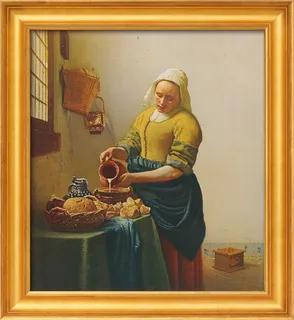
Vermeer showed his figures in works such as "Maid with Milk Jug", "The Art of Painting" or "The Astronomer" in typical everyday situations. The Dutch painter took on the role of a silent observer. He captured people in moments when they were deeply absorbed in their activity.
Jan Vermeer was also among the first painters to engage intensively with the effect of light in his works. He positioned light sources very strategically and controlled their intensity, reflections and cast shadows very meticulously. This also applies to his undoubtedly most famous portrait "The Girl with a Pearl Earring". Against the dark background, the young woman glows in bright colours.
He also always placed great importance on reproducing the mood of the light in his landscapes, such as in "Landscape with Ruins" or "View of Delft".
Vincent van Gogh (1853–1890)
Dutch painting certainly has its most important and most famous representative in Vincent van Gogh. Van Gogh was a great visionary of 19th-century painting. His painting style is today located between Impressionism, Pointillism and early Expressionism.
As one of the first in the 19th century, he distanced himself from a painting tradition that wanted to come as close as possible to reality. Instead, he allowed subjective impressions as well as an individual expression to flow into his manner of painting.
He reduced the details of the pictorial objects and devoted himself more strongly to the atmosphere of his motifs. For this, the famous Dutch painter developed a very individual and unmistakable painting style: he often did not work with fine, continuous lines, but with broad brushstrokes and strong dots. Despite the staccato-like application of paint, van Gogh's paintings create a harmonious overall impression with a fascinating dynamism.
Vincent van Gogh created some of the best-known works of Dutch landscape painting in his career. These include, among others:
- "The Starry Night",
- "Wheatfield with Cypresses",
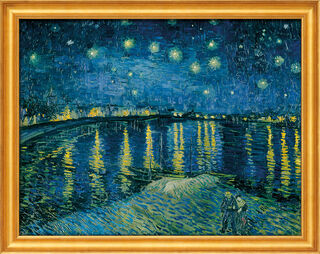
- "Starry Night Over the Rhône",
- "Café Terrace at Night in Arles" and
- "Church of Auvers-sur-Oise".
In addition, he created seascapes, still lifes, several self-portraits and a series of his world-famous sunflower paintings.
Piet Mondrain (1872–1944)
Piet Mondrian played a significant part in the development of abstraction in painting at the beginning of the 20th century. At the start of his career, he still primarily created traditional figurative landscapes. Under the influence of Impressionism and Cubism, however, the Dutch painter began to free himself more and more from representational depiction.
In 1917, he was among the co-founders of the artists' group "De Stijl". The avant-gardists' concept was based on a minimisation of the means of design in art and architecture. Mondrian, for his part, saw in an abstract and simplified form of expression the path to the greatest possible harmony. He developed an unmistakable visual language that essentially relied on black lines, simple geometric forms such as squares and rectangles, and primary colours applied in large areas. He also used this manner of painting in his famous series "Composition with Red, Blue and Yellow" and "Composition in Black and White".
Mondrian also created somewhat less strict arrangements such as "Tableau No. 1" or "Composition No. 2", in which he chose freer forms and broke up the strict parallel line guidance.
Piet Mondrian's individual style brought about groundbreaking changes in the painting of classical modernism and continues to influence art and design to this day.
Dutch Painting and Its Contribution to Art History
Art history owes a great deal to the Netherlands. Dutch painting made a significant contribution to the development and shaping of various styles such as Baroque, Expressionism or abstraction.
Some of the most famous works of all time originated in the Netherlands:
- "The Night Watch",
- "The Girl with a Pearl Earring",
- "Starry Night" or
- "Composition with Red, Blue and Yellow".
The works of Dutch artists such as Vincent van Gogh, Rembrandt or Jan Vermeer are still very popular with the public today. They are regularly shown in exhibitions and achieve top prices at auctions. Some painters from the Netherlands have even been dedicated their own museums:
- "Museum Villa Mondriaan" in Winterswijk,
- "Van Gogh Museum" in Amsterdam".
Selected Works on Famous Artists of Dutch Painting