The Great Painters of Romanticism: Friedrich, Turner, Spitzweg
In Romanticism, the inner life of the human soul took centre stage in art, literature and philosophy. The epoch extended roughly from the end of the 18th century to the middle of the 19th century. In this time of great political and social upheaval, many people concentrated on themselves.
The painters of Romanticism explored their emotional world, took an interest in spiritual and mystical themes, and cultivated a close connection with nature. This attitude to life was also reflected in the painting of Romanticism.
- The longing for the infinite: epic, often melancholic landscapes.
- The world of myths: a return to spiritual and mystical themes.
- The idyll of everyday life: the depiction of peaceful, sometimes humorous scenes.
- Existence as a whole: the human being with all their emotions and dreams.
Today, above all, there are three famous painters of Romanticism who symbolically stand for the entire epoch – Caspar David Friedrich, William Turner and Carl Spitzweg. The painting of Romanticism is to be presented using the example of their works.
The Themes of the Painters of Romanticism
The epoch of Romanticism was strongly defined by its distinction from the Enlightenment in Classicism. Its representatives had seen logic and reason as the maxim for all human action. Behaviour guided by reason was meant to pave the way for progress and innovation and solve social problems. The Romantics, however, feared that in a world shaped purely by rationality, the human soul would suffer. They, therefore, wanted to place greater emphasis on the emotional dimension again.
Dreams, Fantasies, Spirituality and Mysticism
The artists of Romanticism concerned themselves with people's emotions, dreams and fantasies but also with spirituality and mysticism. The epoch of Romanticism was also a reaction to political and social changes in the 18th and 19th centuries such as the French Revolution and industrialisation. Many people longed for peace and security. They fled into the idyll of nature, and turned their attention inwards rather than confronting reality.
This attitude to life was also expressed in the themes of Romanticism pictures. The painters concentrated on motifs in which the individual took centre stage – both in a figurative sense and quite literally. In their works, the painters of Romanticism addressed themes such as longing, transience, dreams, fears, passion, and melancholy.
In addition to subjective sensations, however, they also dealt with religious or spiritual motifs. The artists of Romanticism implemented these contents in various groups of motifs, for example in idyllic moments with couples, families or social gatherings, majestic landscapes or dramatic scenes from mysticism and fables.
Landscapes as a Popular Motif
Landscapes formed a major focus in Romantic painting. The painters of Romanticism celebrated the beauty and sublimity of nature in their opulent works. Yet, they did not merely create especially aesthetic and splendid impressions of landscapes. The artists also often charged their motifs with symbolism in order to convey emotions or communicate messages.

Caspar David Friedrich – The Famous German Romantic Painter
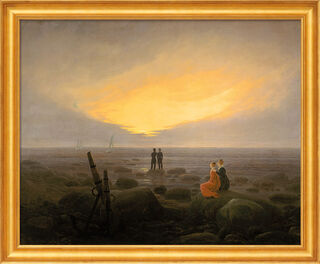
Caspar David Friedrich (1774 – 1840) is the most prominent German painter of Romanticism. Friedrich possessed the unique ability to translate human emotions into pictures of landscapes. He addressed existential questions of human existence by staging fitting scenes of nature and landscape.
His style was characterised by a depiction that was sometimes idyllic, and at other times dramatic. With great perfection and attention to detail, he created almost photorealistic landscape views. Yet, Friedrich was never concerned with a true-to-life documentation of nature. He did indeed take inspiration from real landscapes throughout Germany. In his paintings, however, he then constructed a fictional world out of his impressions.
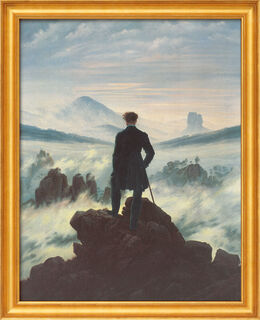
One of Friedrich's most famous paintings is "Wanderer above the Sea of Fog". The painting, created around 1818, shows a man seen from behind. He stands on a rock and looks out over a landscape with imposing, dynamic cloud formations. Friedrich's painting has been interpreted in various ways. Thus, it could stand for the achievement of a goal and a bond with nature, but it could also be interpreted as a symbol of the transition from this world to the next, for melancholy or for loneliness.

William Turner – The Pioneer of Painting With Light
William Turner (1775–1851) is regarded as one of the most significant painters of English Romanticism. By the end of the 18th century, he was already an established figure in the art scene of London. In his early twenties he exhibited his first paintings, and in his late twenties he had already been appointed professor at the Royal Academy.
Turner's preferred picture themes included seascapes, landscapes and city views. The English painter of Romanticism found his motifs not only in his homeland but also on numerous journeys. He painted various sights of Europe, for example the canals of Venice, the Gotthard Pass, the Lorelei rock or Stonehenge.
William Turner reflected the beauty, the mysticism and the power of nature in his works. In order to reproduce the character and atmosphere of his motifs as vividly as possible, he developed a way of painting that was virtually revolutionary for his time. Instead of limiting himself to depicting his motifs realistically, he wanted to convey something of his subjective perception in his works. He is said to have once remarked:
"My task is to paint what I see, not what I know is there"
Consequently, he did not focus on fidelity to detail and realism but on rendering the lighting conditions, the play of colours and the mood of the moment.
In his painting "The Grand Canal Venice" from 1835, he concentrated on the dazzling light of that single moment, as well. Both the clouds in the sky and the bright buildings reflect the sunlight. Turner merely sketched the buildings to the left and right of the canal. Furthermore, he dissolved the contours of the houses more and more the further they recede into the background of the picture. With this way of painting, William Turner is today regarded as a major forerunner of Impressionism.

Carl Spitzweg – The Mischievous Chronicler of His Time
Carl Spitzweg (1808 – 1885) is the best-known painter of the Biedermeier epoch. This epoch extended in Germany from the beginning to the middle of the 19th century and thus fell within the phase of Late Romanticism. The two epochs not only overlapped in time.
The characteristics of Biedermeier art showed clear parallels with Romanticism. Carl Spitzweg stood entirely in the tradition of romantic painting, as well. He mastered an extremely realistic style of painting. He worked out the pictorial objects in great detail in order to make them appear as true to life as possible. His motifs included idyllic landscapes and genre scenes.
Spitzweg often portrayed somewhat eccentric outsiders, as for example in "The Poor Poet" (1839). In this painting, he treated the somewhat romanticised profession of the writer satirically. He showed the poet as a man who apparently goes about his work while lying in bed during the day. He lives alone in a small, sparse and presumably cold flat but does not seem to be unhappy. Today, one would say that Carl Spitzweg created with this painting a symbol of the well-known expression "starving art".
Even After 250 Years, Romantic Painting Is Still Relevant
Even though the painting of Romanticism initially lost some of its importance from the middle of the 19th century onwards, it still had a major influence on various subsequent artistic epochs.
Many impulses set by the painters of Romanticism were developed further in subsequent styles. For example, the impressionists were inspired by the way William Turner depicted light and atmosphere. The style of depiction in Romantic art that was intended to be as true to reality as possible was also taken up again later, for example in New Objectivity at the beginning of the 20th century. Even in contemporary culture, the traces of the romantics and their outlook can be recognised again.
Women and Men Painters of Romanticism Are Very Popular Today
The works of artists of Romanticism such as Caspar David Friedrich or William Turner still enjoy great popularity. Their visual language is so universal that even after more than 250 years it continues to fascinate and move audiences. Their popularity is due in no small part to the fact that they addressed themes that concern all people regardless of the historical context, for example love, longing or melancholy.
Moreover, today many people once again seek security and idyll in the face of continuing major crises in the world. As in the epoch of Romanticism, withdrawal into private life increasingly appears to be a way out. Thus, at their core, numerous social media trends today take up romantic ideas. For example, idealised landscape motifs are celebrated or homely cosiness is glorified. Evidently, the art of Romanticism and its message are still current and contemporary nowadays.
Selected Works on the Great Painters of Romanticism