Picasso and the Doves
It is one of the most important political symbols of the 20th century – the dove of peace. For over 70 years, it has appeared on posters, T-shirts, and flags against war, violence and rearmament.
Pablo Picasso (1881 – 1973) played a significant part in the dove becoming a symbol of peace. Although the probably most important artist of the 20th century and pioneer of the avant-garde did not invent the dove of peace, without his picture of a white dove from 1949, the peace movement might possibly not have one of its most important symbols today.
Doves played a significant role throughout Picasso's entire oeuvre. The story of the dove of peace shows how a lithograph of one of Picasso's favourite animals could become a milestone of political art. The following art report will explore, among other things, the significance of the dove as a motif in Picasso’s biography, the technique he used for his 1949 version, and how this motif was able to develop into a symbol of peace.
Why Did Picasso Paint Doves?
Picasso's fondness for doves as motifs for his works is rooted in the biography of the Spanish painter. Doves played a significant role not only in his art, but in his entire life.
Pablo Picasso generally had a very special relationship with animals. It is said that he valued them far more than people. Since his childhood, he had lived together with various animals, for example dogs and goats. He had a very close bond with doves.
A look at his biography reveals numerous moments in which these birds played a role. He was surrounded by doves already in his parents' home. His father Don José Ruiz Blasco kept some doves and produced numerous pictures of them. Later, Pablo Picasso also kept some of these birds.
Through the close contact that Picasso had with doves already as a child, he also made them motifs of his works at an early stage. One of his most famous pictures, "Child with Dove" (1901), thus shows his favourite bird in the hands of a little girl.
In the following decades, doves repeatedly appeared in Picasso's works:
- In 1949, he designed the version that would later go down in art history as his first dove of peace.
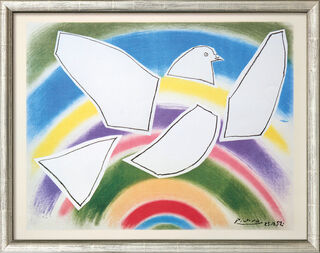
- In 1952, he created a fragmented dove of peace with "Flying Dove in the Rainbow".
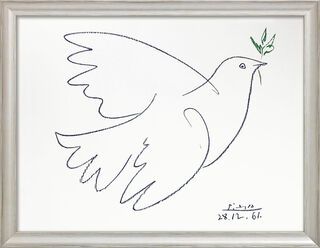
- A version from 1961 also became well known, which was used on a poster for a peace congress in the French town of Issy-les-Moulineaux in 1962. In this lithograph, Picasso defined the contours of the dove with an olive branch in its beak using only a few lines.
- Picasso also repeatedly returned to his favourite birds in non-political works. "The Doves II" from 1957 shows a view of a balcony with several doves, and "Dove with Green Peas" (1911) a strongly abstracted interpretation in the style of Cubism.

How Picasso’s Dove Became a Symbol of the Peace Movement
The story of the dove as a worldwide symbol of peace began in Paris in 1949. A lithograph by Picasso of a white dove was used for a poster for the first World Peace Congress, which took place in the French capital in the same year. However, Picasso had never planned for his picture of a dove to be used for this purpose.
The Use of the Dove as a Political Symbol Was Not Originally Planned
The motif of the dove had accompanied Picasso since his youth. He repeatedly returned to his favourite birds in his paintings and lithographs. One of these works then became an icon of the peace movement rather by chance. In January 1949, his friend, the poet and writer Louis Aragon, who was involved in the World Peace Movement, visited him. He was looking for a motif for a poster for the World Peace Congress, which was planned for Paris in the same year. His choice fell on the lithograph of a white dove that Picasso had produced immediately beforehand.
In contrast to the abstracting style for which Picasso would later become famous, he had chosen a largely realistic depiction here. This is also said to have been one reason why Aragon selected this picture. Picasso's dove did not appear too complex and was easy to recognise. In addition, it may have suited Aragon that this work was already a lithograph. This meant the motif could be reproduced on posters without great effort.
What Does the Dove Stand for as a Symbol?
The dove's already existing great symbolic power is also likely to have been a reason for its selection. This rested on various stories from the Bible.
- In the Old Testament, a dove is reported in connection with the Flood. With its olive branch in its beak, it signalled to the people on Noah's Ark that it had found land. The dove therefore also symbolises peace between God and humankind.
- In the New Testament, the dove appears as a symbol of God, because here God's spirit comes to earth in the form of a white dove. It can be assumed that Picasso and Aragon were aware of these biblical meanings when they chose the dove.
The symbolically charged bird was then also to take centre stage on the poster for the peace congress. Only the inscription "Congres Mondial des Partisans de la Paix" ("World Congress of the Fighters for Peace"), together with the date and venue, was added to the lithograph. This poster was put up all over Paris and, through its wide circulation, was able to establish itself as an icon of peace.
In the following years, Pablo Picasso created further variants of the dove for various peace congresses. He contributed designs for posters for events in Berlin, Rome and Moscow, among others. Ultimately, however, it is the 1949 poster that explains why the dove acquired its defining character as a sign of pacifism. This idea was quoted and copied countless times in the following decades. Through its repeated use at further events devoted to peace and international understanding, this motif became a central icon of the peace movement.
Motif Design and Technique of Picasso’s Dove
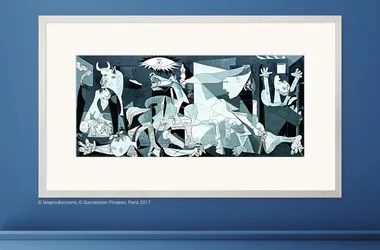
Pablo Picasso is now regarded as one of the leading minds of the avant-garde of the 20th century. Together with Georges Braque, he developed Cubism and in doing so became a pioneer of abstraction. Many of his famous works such as "Les Demoiselles d’Avignon" (1907) or "Guernica" (1937) come from the phase in which he increasingly left realism behind. Even so, Picasso repeatedly also returned to the figurative style of the old masters and of Classicism.
Picasso's dove from 1949 also does not seem to fit entirely with the image of the radical renewer of painting. In contrast to his cubist works, in which all the laws of nature seem to have been suspended, Picasso returned with this dove to an almost traditional mode of representation. Here he created no complex picture structures with abstracted objects, but simply placed a single dove at the centre.
He shaped its proportions almost true to nature, although he dispensed with many details. He defined only the head and the tail feathers more clearly. For by far the greater part of the plumage, he left it as a large white surface. In this way, he achieved the effect of a strong light-dark contrast. It seems as though the dove is stepping out of the darkness that surrounds it.
Picasso produced the prints of "La Colombe" by means of the lithographic printing process. The black-and-white lithographs were created in the studio of Fernand Mourlot in Paris. He was highly esteemed by many artists of Modernism because of his perfect craftsmanship. Besides Picasso, Georges Braque, Marc Chagall, Henri Matisse and Joan Miró also worked with him.
The Dove of Peace as a Political Motif
After the Second World War, Picasso's dove gained worldwide significance in politics and society. To this day, the dove of peace is used by a wide variety of political parties and groups for their own purposes.
After Picasso first made his dove available in 1949 for the "World Congress of the Fighters for Peace", he produced further variants of the dove for these congresses for many years. Very soon, this motif began to take on a life of its own. Numerous other painters and graphic artists adopted it and created their own versions of the dove of peace. Yet it always retained its value as a symbol of pacifism.
Naturally, however, the different political and ideological camps have very different ideas of the concept of peace, or of how peace is to be achieved and maintained. As a result, the dove as a symbol of peace is frequently interpreted and instrumentalised by many actors in their own sense.
Already in its first use as a sign of peace, the dove was ideologically marked. The World Peace Congress in Paris, for which the poster with the dove advertised, was organised by the "Comintern", an alliance of international communist parties. In the following decades, the dove of peace was used in a wide variety of contexts. In the GDR in particular, it counted among the most frequently used political symbols. The SED regularly decorated its party congresses and other state events with the dove of peace.
But the dove also served as a symbol of identification in the worldwide peace movement, for example at demonstrations in the USA against the Vietnam War. In the Federal Republic as well, flags with the white dove often flew at demonstrations, for example at the beginning of the 1980s during the protests against NATO's Double-Track Decision, which provided for the deployment of nuclear missiles in Western Europe.
At the same time, the peace symbol also appeared at pro-Russian demonstrations and events organised by the Reichsbürger. This shows that the dove of peace is by no means linked to a clear, overarching message or political position. Rather, its use and meaning appear to be very arbitrary and are purely dependent on the respective interests and aims of political actors.
Picasso’s Dove Today – Popular Museum Exhibit and Motif of the Visual Arts
Several copies of the original edition of Pablo Picasso's dove of peace still exist today. Picasso had produced a series of lithographs of the dove with Fernand Mourlot. They produced five artist's proofs as well as fifty signed and numbered prints on handmade paper. This edition was later published by the Paris gallery Louise Leiris.
In the following decades, Picasso repeatedly devoted himself to the motif of the dove. Many of these variants also now belong to the collections of renowned art museums, for example the Museum of Modern Art, New York, or the Museu Picasso in Barcelona.
When Picasso made his dove available for the World Peace Congress in 1949, he certainly could not have guessed what significance it would one day have for art, politics and society. Yet the dove still possesses great expressive power right up to the present as a universal symbol of peace. The dove of peace also inspired numerous famous artists of the 20th and 21st centuries, including Markus Lüpertz, A.R. Penck and Georges Braque.
In 2007, the street art artist Banksy created his very own version of the peace symbol. In Bethlehem, he sprayed a white dove wearing a bulletproof vest with a crosshair on its chest onto a building riddled with bullet holes. This and many other contemporary interpretations of the dove of peace suggest just how relevant the dove still is today as a symbol against war and violence.
Selected Articles on Picasso and the Doves