Les Demoiselles d'Avignon: Why This Work by Pablo Picasso Shook the Art World
In art history, it is not uncommon for works that are now recognised as milestones of art to have initially been met with incomprehension in their time. This was also the case with "Les Demoiselles d'Avignon" by Pablo Picasso.
When, in 1907, the Spanish painter presented the imposing painting, measuring approximately 2.44 x 2.34 metres, many viewers reacted with rejection. The criticism was directed both at the unconventional style and at the motig featuring five naked women.
Today, however, the perception of the painting has changed completely. It is indisputably regarded as one of the most important paintings of the 20th century and is among the famous works by Pablo Picasso. At most, there is disagreement about how significant the influence of this picture on painting should be considered. Some regard it as one of the most important works on the path towards Cubism and Abstraction, while others even see the painting as a turning point in Modern Art as a whole.
There are essentially four aspects that are particularly worth highlighting in connection with "Les Demoiselles d'Avignon":
- Both the painting style and the motif were provocative to many of Picasso's contemporaries.
- In his imagery, Picasso broke with several traditions of painting.
- He worked with influences from the art of different cultures.
- Over the decades, the reception, interpretation and evaluation of the painting changed within the art world.
These four points will be examined in more detail below. The aim is to trace how the painting, which was initially heavily criticised and ridiculed, developed into one of the most important and fascinating works of art in the world.
Picture Analysis of "Les Demoiselles d'Avignon" – A Provocation of Form and Content
The very first reactions of his contemporaries made it clear that Picasso had presented anything but a traditional painting with "Les Demoiselles d'Avignon". Both in his choice of motif and in the form of its depiction, he broke with many expectations and conventions.
The Motif Provoked and Posed Questions
The women in Pablo Picasso's life and the portraits he created of them during his career have been discussed by art historians in numerous articles. However, "Les Demoiselles d'Avignon" occupies an exceptional position even in this context.
At the beginning of the 20th century, such a motif was still regarded a breach of taboo. The "Young Ladies of Avignon" are quite clearly prostitutes. The choice of this motif alone caused a stir, as such a scene was generally considered not to belong in the world of high culture. According to Picasso, the painting shows a scene from a brothel on Carrer d'Avinyó in Barcelona.
In an initial draft, Picasso had placed two gentlemen alongside the five ladies. In the final version from 1907, however, he reduced the people in the picture to five scantily clad or naked women. Picasso gave each of the ladies a highly individual character and depicted them in different postures. Four of the women are standing, while only one of them is seated in the lower right-hand section of the picture. The two women in the centre of the picture have their arms folded behind their heads.
The different treatment of the faces is striking. The woman on the left edge of the picture has noticeably dark skin. For the two ladies in the centre of the picture, Picasso chose very similar, highly stylised facial features. The two women on the right edge of the picture form a clear contrast, with faces that resemble grotesque masks. Picasso focused everything in this painting on these five women. He added only a plate of fruit at the bottom edge of the picture as the sole inanimate pictorial object. This is a homage or reference to the classical genre of still life. However, there is no record of what purpose Picasso intended it to serve.
The Style Contradicted All Established Rules
In "Les Demoiselles d'Avignon", Picasso demonstrated courage, creativity and a pioneering spirit. Here, he defied all the rules of painting that applied to the depiction of the human body at the time.
At the beginning of the 20th century, painters still largely based their work on natural forms. Picasso, however, no longer wanted to depict the world as realistically as possible. Instead, he sought to give his paintings an independent aesthetic effect. To achieve this, he fundamentally reinterpreted the forms and proportions of the bodies. He transformed many contours from naturally rounded and curved lines into angular, often even geometric forms. He dispensed with most details and reduced body parts such as arms or legs to simple basic forms. Through this abstracting style of representation, he distanced himself from the traditional aesthetics of portraits and offered a new perspective on this genre.
Picasso placed four main emphases on the use of colour in the painting:
- For the women's bodies, he primarily used beige, ochre and pink. He designed the background of the picture with a colour gradient from left to right. Three colour zones can be identified.
- On the far left, strong and dark colours such as brown and red dominate. Towards the centre of the picture, shades such as white, grey and silver create a contrast. From the centre of the picture towards the right, pale shades of blue are also added.
- For the background of the picture, Picasso did not use large areas, but composed it from many smaller fragments of different dimensions and colours.
- He did not follow a specific pattern for the areas of colour, but varied their form.
Picasso Also Disregarded Perspective and Spatiality
However, Picasso did not defy the conventions of painting that were customary at the time only in his style of depiction. He also dispensed with central perspective. This form of pictorial composition, which is based on a central vanishing point, had been used since the Renaissance to create the illusion of spatiality and distance. In "Les Demoiselles d'Avignon", however, Picasso rejected any sense of spatial depth. All pictorial objects and the background appear to lie on a single plane.
Another particularly unusual aspect is that he apparently painted one and the same figure from different angles. The seated woman in the lower right appears to be shown from behind. At the same time, Picasso shows her face from the front. By playing with perspectives, Picasso ensured that the viewer's eye searches in vain for a realistic arrangement of the pictorial objects and a spatial order.
The abstracting forms and two-dimensionality that Picasso applied here later also became essential characteristics of Cubism. Picasso had developed this painting style together with Georges Braque. "Les Demoiselles d'Avignon" is therefore also regarded as a pioneering work in which Picasso had already experimented with some of the stylistic characteristics of Cubism.
Picasso Drew Inspiration from Art from Different Cultures
Pablo Picasso created a milestone of Classical Modernism with this work. However, some of the numerous picture analyses of "Les Demoiselles d'Avignon" claim to have identified significant influences from artists of other epochs. In this context, the series "The Bathers" by Paul Cézanne is repeatedly mentioned. References to these works by Cézanne can be recognised in "Les Demoiselles d'Avignon", both in the subject and in the style.
Nevertheless, interest usually focuses on the influence of non-European cultures on Picasso's work. These interpretations primarily refer to the faces of the two women on the right edge of the picture. Picasso did not stylise these like the other faces in the picture, but literally placed masks on them. These masks evoke associations with works by artists from Africa and Oceania, although no more specific attribution is possible.
This impression is not entirely unfounded, as Picasso showed great interest in works of art from the African continent. He had frequently visited the "Musée d'Ethnographie du Trocadéro", a large anthropological museum in Paris. Under the impression of the exhibitions there, he is said to have begun acquiring corresponding exhibits himself and painting masks in the style of African and Oceanian works. However, Picasso always denied that they had a direct influence on his art. He may well have conceived the idea for the painting after a visit to the Trocadéro. Yet, it was not the form of the masks that played a role, but their "exorcistic" character.
With his evident references to non-European cultures, Picasso followed the idea of "Primitivism". In Classical Modernism, this term articulated the longing for artistic forms of expression that were free from the academic rules of the European art world.
Many artists sought this untouched quality and originality in the art of Africa, Asia and Oceania. In this context, it is important that the art of indigenous peoples must not be described as "primitive" in the sense of being underdeveloped and backward. "Primitivism" merely describes the practice of European artists incorporating the art of other cultures into their works.
Analysis of "Les Demoiselles d'Avignon" – The Painting's Effect on the Audience
At the beginning of the 20th century, "Les Demoiselles d'Avignon" provoked reactions ranging from horror and astonishment to ridicule when it was first presented. Both the depiction of naked women and the unconventional style were rejected by many viewers. Although these two points would probably no longer cause a stir today, the work is still capable of creating a striking effect.
The painting undoubtedly radiates great energy. Due to the many sharp angles and angular forms, the picture can appear disharmonious and restless at first glance. Some picture analyses even claim to recognise a certain aggressiveness in the painting. This is said to result not only from the radical reinterpretation of the bodily forms and the deformed contours. The masks of the two women on the right-hand side of the picture also appear eerie and threatening.
Furthermore, many picture analyses of "Les Demoiselles d'Avignon" draw attention to the relationship between the women and the viewers. At least two of the five ladies look directly at the audience. If it is assumed that the women are prostitutes, the viewers therefore take on the role of clients inspecting the ladies.
At the same time, however, the women also observe the people standing in front of the canvas. Through the women's fixed gaze, Picasso created a form of interaction with the viewers, who thereby become part of the work of art.
Despite Initially Negative Reactions, the Picture Achieved Worldwide Fame
After Pablo Picasso had completed "Les Demoiselles d'Avignon", he initially showed it only to a small circle of friends, artists and art connoisseurs. Even then, the reactions varied widely and ranged from harsh criticism and incomprehension to scorn and ridicule.
There was also little positive feedback from gallery owners. Both Daniel-Henry Kahnweiler and Ambroise Vollard, who later consistently supported Picasso, showed little interest. The art critic Félix Fénéon is even said to have described the painting as a kind of caricature.
From Dust Collecter in the Studio to Drawing Crowds at MoMA
Perhaps it was because of the initially reserved to openly critical reactions that Picasso initially kept the painting under lock and key. He stored it in his studio for a long time.
It was not until 1916, almost ten years after its completion, that it was exhibited publicly for the first time at the Galerie Barbazanges in Paris. It took until 1924 for Picasso to sell the painting to the fashion designer and art patron Jacques Doucet. In 1939, the Museum of Modern Art in New York acquired the legendary painting for its collection. Today, it is one of the museum's greatest audience favourites.
Significance for Cubism and Art History
Today, there is widespread agreement that Picasso presented one of the most important works in art history with "Les Demoiselles d'Avignon". However, describing it as the first Cubist painting would probably go too far.
It is true that Picasso had already used or suggested stylistic characteristics here that would shortly afterwards become characteristic elements of Cubism. These include the
- reduction of pictorial objects to geometric forms,
- departure from conventional proportions and
- two-dimensionality achieved by dispensing with spatial depth.
Picasso also experimented here with different perspectives on the objects in the painting. He undoubtedly demonstrated a pioneering spirit with this work. He disregarded several standards of painting at once and opened up entirely new possibilities for pictorial composition. In doing so, he paved the way not only for Cubism, but also for Abstraction.
Further Interesting Facts About the Works of Pablo Picasso
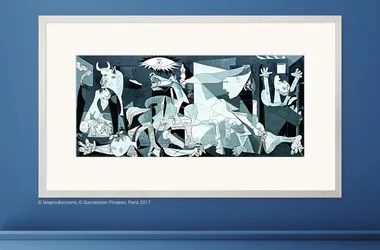
Many facets of this famous painting by Picasso have been explored in this article. If you are interested in further works by the Spanish painter, we recommend our magazine articles on "Picasso and the Doves" and "Guernica" – A Memorial Against War”.