Salvator Mundi by Leonardo da Vinci: A Mysterious Work of the Renaissance
November 15, 2017, is likely to go down as one of the most memorable moments in art history: At Christie's auction house, an anonymous buyer acquired the painting "Salvator Mundi" for $450 million. The work, attributed to the Renaissance artist and universal genius Leonardo da Vinci, is thus the most expensive painting of all time to have been sold at auction.
Not only the purchase price of da Vinci's portrait of Jesus Christ divides the art world. Some critics consider it vastly overrated and of no particular artistic value, while others speak of an overwhelming aura and praise da Vinci's unique perfection. It is said that some viewers even burst into tears upon seeing the painting.
However, the work not only polarises experts and the public, it also repeatedly makes headlines. There is ongoing speculation about who currently owns the painting and where it is stored. Even the question of whether da Vinci actually painted the work himself remains unresolved to this day. Allegedly, Salvator Mundi even caused political tensions between France and Saudi Arabia. These and many other anecdotes make the biography of Salvator Mundi one of the most mysterious and exciting cases in art history.
Image Analysis of Salvator Mundi: Da Vinci's Interpretation of a Traditional Motif
"Salvator Mundi" is believed to have been created around the turn of the 15th to the 16th century. It depicts Jesus Christ in a frontal portrait against a dark background. The 66 x 46 cm painting was created using oil colours on walnut wood. Like many works of art from the High Renaissance, the portrait is highly detailed and has natural proportions. It was painted using the so-called sfumato technique, of which Leonardo da Vinci is considered the inventor.
In da Vinci's Salvator Mundi, this technique is particularly noticeable in the facial features, which appear very soft. By contrast, other elements, like the hair curls or the embroidered pattern on the garment, show the fine lines very clearly.
The Origins of the Christ Motif
A look back into art history is useful when interpreting Salvator Mundi. Here, Leonardo da Vinci portrays Jesus as the "Saviour of the World" - in a frontal view with a raised, blessing hand and a crystal orb. This form of depicting Christ was widespread during the Renaissance. It has its roots in the image type of the "Pantocrator" (meaning "Ruler of the World"), which developed as early as the 6th century. In that motif, Jesus is already shown with a blessing hand gesture. His head is surrounded by a cross nimbus - a halo with a cross - and he is holding a Gospel.
In the late Middle Ages, the motif of the "Salvator Mundi" emerged, where the Gospel was usually replaced by a crystal orb, which was usually used in portraits of secular rulers. In this context, the orb symbolised Christ's dominion over the world. The halo, however, varies: Some painters omitted the cross, others left out the halo altogether, and sometimes it was complemented with Christograms or scrolls.
In Leonardo da Vinci's Salvator Mundi, the symbolism focuses on the blessing hand and the crystal orb. Christ raises his right hand in a gesture of blessing. His fingers form the letters "IC-XC", an abbreviation for "Jesus Christ".
The Mystery of the Crystal Orb

Many analyses of Salvator Mundi have closely examined the crystal orb. A recurring question concerns the lack of light diffraction or distortion inside the orb. This would have been expected if it were solid glass. Given da Vinci's in-depth knowledge of the natural sciences, it seems unlikely that this was an error.
A team of researchers from the University of California presented a plausible answer: A 3D simulation of the sphere revealed that da Vinci most likely intended to depict a hollow orb with a thin glass wall. In that case, the image would be physically correct.
Another striking feature of the entire composition is that da Vinci omitted two central religious features: the cross nimbus and the cross atop the orb. This has been interpreted to mean that the natural scientist and polymath sought to present a secular view of Jesus Christ with his form of depiction.
Salvator Mundi Changed Hands Multiple Times
Salvator Mundi by Leonardo da Vinci made headlines not only because of its spectacular purchase price but also due to its convoluted provenance. However, the list of owners of this 500-year-old painting is incomplete.
The first known owner was King Charles I of England, with Salvator Mundi supposedly being part of his collection from 1649 to 1736. Subsequently, the work is said to have been in the possession of the Duke of Buckingham and later passed into the collection of the English textile merchant Sir Frederick Cook. This is where the story of Salvator Mundi begins. Cook's heirs are said to have sold the work in 1958 for £45 to the American furniture dealer Warren E. Kuntz. At that time, it was not attributed to da Vinci, but to one of his students.
Around 60 years later, it resurfaced. In 2005, the New York art dealer Robert Simon acquired the work at auction for around $1,200. It is said to have been heavily overpainted and in a very poor overall condition. Simon commissioned the renowned restorer Dianne Modestini to return the work to its original state. After the restoration, the National Gallery in London exhibited the painting as an original by da Vinci.
Following this "knighting", Leonardo da Vinci's Salvator Mundi travelled through several auctions - with a never-ending price increase. In 2013, Swiss art dealer Yves Bouvier purchased the work for $80 million - only to sell it immediately to Russian entrepreneur Dmitry Rybolovlev for $127.5 million. In 2017, the spectacular auction at Christie's followed, where the artwork was sold for a record-breaking price of $450 million. However, the identity of the buyer remains unclear.
After the auction, it disappeared from the public eye and various rumours circulated about where it was kept. Once it was said to have been sighted in Saudi Arabia, another time it was rumoured to be hung on a yacht belonging to the Saudi Crown Prince. In 2024, the BBC reported that the work was stored in a freeport facility in Geneva - the most recent theory regarding its whereabouts.
Despite the High Price, Doubts About the Authorship Remain
In addition to the provenance, it remains unclear whether Leonardo da Vinci was responsible for Salvator Mundi at all. When Warren E. Kuntz bought the painting for $45, no one believed it to be an original by da Vinci. Only in 2005 did suspicions arise that it might be a work by the Italian Renaissance master after all.
Numerous theories are now circulating which are supposed to prove that Salvator Mundi was not painted by da Vinci. Caution is required when attributing authorship because the work has been painted over several times, damaged and finally heavily restored. For this reason, the painting style of a particular artist can hardly be identified beyond doubt.
Some critics even suggest that the restorer Modestini deliberately wanted the work to look like a work by da Vinci and manipulated it accordingly. Others point to stylistic inconsistencies: For example, the face in comparison to other da Vinci works, allegedly lacks expressiveness.
Doubts were also raised by a team of experts at the Louvre in Paris about the authenticity of the painting. After months of analysis, including X-ray examinations in June 2018, the team came to the conclusion that Leonardo da Vinci was not the original artist. Instead, the painting may have been painted in his workshop by one of his students. However, da Vinci was at best responsible for a few small additions. Consequently, the Louvre experts refused to recognise the work as an original.
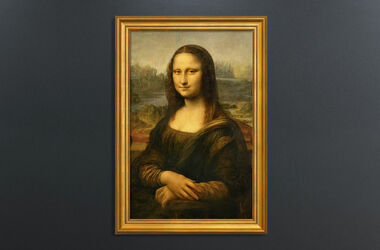
Other analyses, however, concluded that the work could indeed be genuine. These often refer to the painting's technique. According to these analyses, the similarities between Salvator Mundi and other paintings by da Vinci are obvious. For example, the mouth area is clearly reminiscent of the smile of the "Mona Lisa". The filigree curls of hair and the refraction of light in the crystal orb also point to da Vinci as the creator. There were also preliminary studies of the Saviour's garment that could demonstrably be attributed to da Vinci. These sketches were directly related to the painting.
Despite all attempts at explanation, the question of who painted the Salvator Mundi remains unanswered to this day. There will probably never be complete certainty - ensuring the myth of the painting endures.
Even After the Auction, the Salvator Mundi Confusion Continued
Even before 2017, the painting’s unclear provenance and numerous ownership changes had made its story almost legendary. But the auction at Christie’s was undoubtedly the climax. All doubts about authenticity seemed irrelevant.
Before the auction, the estimated price stood at about $100 million - but it was far surpassed. After 20 minutes of bidding, the final price reached $450 million. The auction house did not reveal the identity of the buyer. It was assumed that two investment companies were involved. However, the spectacular sale meant that the painting did not fade from public attention. Instead, the confusion surrounding its location and ownership, as well as renewed questions about its authenticity, continued.
The investment companies, the supposed buyers, had presented a plan to display the painting long-term at the Louvre Abu Dhabi. However, an exhibition planned for 2018 never took place. The museum gave no reason for the cancellation and with the cancelled exhibition, the painting's trail went cold. Or perhaps the story took an even stranger turn?
Apparently, Saudi Crown Prince Mohammed bin Salman acquired the painting, possibly on behalf of Abu Dhabi’s cultural authority. During a state visit to Paris in April 2018, he and French President Emmanuel Macron reportedly agreed to display the supposed da Vinci in a major Louvre exhibition in 2019.
However, the Crown Prince reportedly demanded that Salvator Mundi be exhibited right next to the Mona Lisa. The Louvre in Paris was sceptical and commissioned another extensive analysis of Salvator Mundi. The team of experts was unable to establish beyond doubt that it was an original by da Vinci. They recommended that the work should not be exhibited without a corresponding explanation.
Bin Salman, displeased by the result, allegedly threatened to withhold the loan and sabotage a planned multi-billion-euro economic project between Saudi Arabia and France. There was a threat of a serious strain on relations between the two countries. The French Foreign Minister reportedly pressured the Louvre experts to recognize the painting as a genuine "da Vinci". In the end, President Emmanuel Macron ultimately supported the Louvre team in their view that the picture might not be by da Vinci. As the experts were not one hundred per cent sure, he did not want to take any risks. The reputation of the Louvre as a renowned art institution and thus the reputation of France as a whole was at stake.
As a result, Saudi Arabia withdrew the painting from the exhibition. Since then, there has been no trace of the whereabouts of Salvator Mundi. In his film, Antoine Vitkines offers plausible theories and credible interviews. However, even he was unable to answer all the questions surrounding Salvator Mundi.
The Story of Salvator Mundi Is a Lesson About Today's Art Market
The biography of Salvator Mundi by Leonardo da Vinci still contains more questions than answers. However, the history of this painting certainly teaches us a lot about the mechanisms and the current state-of-the-art market - especially the highest price segments.
Given a price of nearly half a billion dollars, one must wonder: how is the value of art determined today? Pure artistic achievement alone can no longer explain such sums. Value now lies in the prominence of the artist, the exclusivity of the work, and public fascination.
Moreover, today, particularly expensive paintings and sculptures are increasingly used as prestige objects and status symbols. Buyers seem to be less interested in the work itself, its artistic execution or the aesthetic enjoyment of art. Rather, it is all about the prestige that one supposedly enjoys as an owner.
Even if an ultra-expensive piece like Salvator Mundi were proven to be a forgery, it would still serve a purpose: showcasing the buyers’ ability to casually spend enormous sums, even on something potentially worthless.
Another factor contributing to the increase in value is the fact that the art market nowadays generally enjoys a very high level of attention and appeals to larger groups of buyers. This includes both private individuals and commercial enterprises. Works of art are now traded in the same way as other economic goods. They serve as capital investments and speculative objects and can be found in many investment funds and bank portfolios. Given the structure of the current market, it’s likely that the $450 million record will not remain unbroken for long.