The Bust of Nefertiti – Legendary Egyptian Artefact
It ranks among the greatest art treasures in the world: the bust of Nefertiti. Even after more than 3300 years, the image of the Egyptian queen still manages to captivate audiences.
Today, it possesses an appeal that reaches far beyond archaeology. The beauty of Nefertiti, as well as the myth surrounding her, is legendary. Many people regard her as an idol and leading figure. Because of her strong position in her role as ruler, she has even been described as the "first feminist in history".
The influence of Nefertiti extends into the pop culture of modern times. Artists copied her appearance or dedicated pieces of music to her. The original bust is now one of the major sights in Berlin. Hundreds of thousands visit this Egyptian artwork every year in the Neues Museum.
But what accounts for the fascination of this artwork? To get to the bottom of the significance of Nefertiti, her history will be examined in more detail below. Among other things, the circumstances of the discovery of the bust, the mystery of the missing eye and the controversy surrounding a possible return to Egypt will be looked at more closely.
Who Was Nefertiti? Her Role as Queen and Her Legendary Beauty
Nefertiti was a queen of Ancient Egypt who lived in the 14th century BC. She and her husband, the pharaoh Akhenaten, ruled for about 16 years. Nefertiti was considered a strong and self-confident woman who was almost equal to the pharaoh. In addition, Nefertiti was always admired for her beauty.
There is no complete information about the life dates of the legendary Egyptian queen. However, some details of her biography appear to be established:
- It is assumed that Nefertiti was born around the middle of the 14th century BC. She probably belonged to an upper-class Egyptian family; some sources even suggest she was of royal descent. Between the ages of 12 and 16, she married Amenhotep IV, the later pharaoh Akhenaten. Six daughters are said to have resulted from the marriage.
- In her role as the king's wife, she is said to have had great influence on politics and religion. It is said that she was almost equal to her husband and actively supported him in his reign. The assumption that Nefertiti had almost as powerful a position as Akhenaten is supported by numerous depictions on artefacts. On reliefs, for example, she was shown as being the same size as the pharaoh, which indicates a formal equality with her husband. In addition, various artworks have been found in which she is shown defeating her enemies in military conflicts.
- What happened to Nefertiti after Akhenaten's death has not been conclusively clarified. However, there are indications that she survived the pharaoh and may even have ruled alone for several years. When and under what circumstances she died, however, remains unclear.
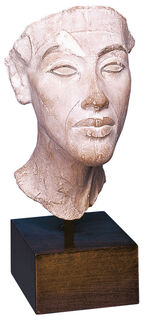
- Nefertiti is not revered only because of her strong personality. She was also considered a very attractive woman. This is already suggested by her name, which is translated as "The Beautiful One Has Come" or "The Beautiful One Who Comes". The image we have of the queen today is based not least on the bust of Nefertiti. Her facial features are rendered in the sculpture almost symmetrically. With her high cheekbones, wrinkle-free skin, narrow nose and full lips, she embodies a timeless, recurring ideal of beauty. The fact that the bust most likely shows the queen in a highly idealised form plays hardly any role in this.
- But it is not only the bust of Nefertiti, but various traditions that contribute to the myth of the "Beautiful Queen". She is said to have spent several hours a day bathing, caring for her body and applying make-up. The bust also allows conclusions to be drawn about how much importance she attached to her appearance. She is shown with elegant make-up, red lips, eyeliner around the eyes and perfectly shaped eyebrows.
Why Does the Bust of Nefertiti Have Only One Eye?
The bust of Nefertiti is said never to have had two eyes. The sculpture served merely as a model in the workshop of the sculptor Thutmose and was therefore never completed. At least, this is one of the most common theories about Nefertiti's mysterious trademark – the missing left eye.
One of the most striking features of the bust is the difference between the right and left eye. The right eye consists of rock crystal, which was attached with beeswax. The left eye socket, however, is empty. Various theories exist as to the reason for this. The archaeologist Ludwig Borchardt, under whose leadership the bust was found in 1912, had assumed that a left eye had never been intended. In his diary, he wrote that no inlay for the left eye was found during the excavations. Nor had any binding material apparently remained in the eye socket with which an eye could have been attached. It is therefore generally assumed that the sculptor Thutmose deliberately did not complete the bust. It is said to have served as a demonstration object on which the production process could be shown. Perhaps it was also intended as a model for further busts.
This explanation has already been questioned on several occasions. It is said, for example, that the bust of Nefertiti could originally have been anatomically complete. Presumably, the left eye simply fell out at some point. The violent removal of the rock crystal is also considered possible. There is also speculation that Nefertiti may have fallen from favour and that the bust was therefore not completed.
Other theories even assume that the bust shows the queen as she really looked. She may have had an eye condition or may even never have had a left eye. The question of why Nefertiti has only one eye will probably never be conclusively answered. The fact remains, however, that the missing eye continues to contribute significantly to the myth surrounding Queen Nefertiti to this day.
Place of Discovery, Age and Material of the Bust of Nefertiti
At the beginning of the 20th century, the reign of Pharaoh Akhenaten was the focus of much Egyptological research. Scholars from all over the world were interested both in his monotheistic religious concept and in the craftsmanship of this period. In Germany, too, there were efforts to become involved in this field of research.
At the end of 1911, a major excavation campaign was finally able to begin under the direction of the German Egyptologist Ludwig Borchardt (1863 – 1938). This was financed by the Berlin entrepreneur and patron James Simon and was officially approved by the Egyptian authorities.
- The place of discovery: The excavations by Borchardt and his team concentrated on the site of Tell el-Amarna in Middle Egypt. Around 1350 BC, Akhenaten had had his new capital built here under the name "Akhetaten". In 1912, the researchers came across a building in the ruins that would soon turn out to be the workshop of the sculptor Thutmose. On 6 December, alongside many other artworks such as portrait heads of the king and his family, they also found the bust of Queen Nefertiti here.
- The material: The bust of Nefertiti weighs around 20 kg and is approximately 50 cm high. However, it was not created from a single piece of material, but was produced in several working stages. This is shown by examinations of the artwork with a computed tomograph. Accordingly, the sculptor Thutmose first produced a basic form from limestone. On this blank, he then modelled all the details of the face and the queen's crown with plaster. In a final step, he painted the bust with colourful pigments. For this, he used various materials such as coloured glass powder, charcoal or lime. Only for the right eye did he choose not to use paint, instead inserting a polished rock crystal as the pupil, which was attached with beeswax.
- The dating: Today it is assumed that the bust was created around 1340 BC. When it was discovered in 1912, it was therefore probably about 3250 years old. However, a reliable statement of the bust's age is not possible. The C-14 method is usually used to examine age. For this technique, however, there is too little organic material on the sculpture, which is necessary for this procedure.
The Bust of Queen Nefertiti – Masterpiece of Egyptian Art
When the Egyptologist Ludwig Borchardt came across the bust of Nefertiti, he knew that he had made a very special discovery. In his written documentation of the excavations, he described it as the "most lifelike Egyptian artwork". The multicoloured portrait was "the finest and most meticulously crafted" that he knew. Indeed, the bust represents an extraordinary example of the precise craftsmanship of Ancient Egypt. In addition, this life-size sculpture has a very special status from both an archaeological and an aesthetic perspective.
Borchardt already pointed in his notes to the extraordinary condition of the artefact. Both the stone or plaster form and the colours are strikingly well preserved. Although the sculpture has some damage, such as small breaks on the ears, chips on the shoulder or scratches on the face, overall it is better preserved than many other finds over 3000 years old.
The perfect state of preservation also explains why the bust of Nefertiti still has an incomparable effect on viewers today. The delicate smile, the even skin and the precisely worked individual hairs of the eyebrows make her appear almost alive. With her proud gaze, she radiates elegance, but also strength. The large blue crown with the golden brow band emphasises her authority and dignity. With these features, she continues to amaze audiences even today.
Does Nefertiti Have to Be Returned to Egypt?
The original bust of Queen Nefertiti now belongs to the collection of the Prussian Cultural Heritage Foundation and is the undisputed attraction in the Neues Museum in Berlin. Yet voices repeatedly call for the bust to be returned to Egypt. Such restitution, however, is currently not being officially pursued either by the Egyptian government or by the German side.
There is no doubt that the bust of Nefertiti is a significant heritage of Egyptian culture. In this respect, a demand for its return to the North African state appears in principle not unjustified. However, the Prussian Cultural Heritage Foundation sees no reason to comply with this, as in its opinion everything proceeded legally both in the excavation and in the division of the finds and their export.
How the Bust Came to Berlin
At the beginning of the 20th century, the involvement of European countries in excavations in Egypt was quite common. The Europeans had the necessary financial means for the excavations, which the Egyptians lacked at that time. It was agreed with the foreign archaeologists that one half of the finds should always remain in Egypt. The archaeological significance of the pieces was also to be taken into account during the division. According to these stipulations, this is also said to have been the case during the excavation campaign led by Ludwig Borchardt from 1911 to 1913.
There are also rumours, however, that he falsely declared the bust to be purely "plaster work". In doing so, he wanted to reduce interest in it, since stone works were considered much more valuable and scientifically more interesting. This deception is said to have made it possible for the bust to pass into the ownership of James Simon, the financier of the excavations.
In 1920, Simon then handed over all the Tell el-Amarna finds to the Berlin Museum – including the bust of Nefertiti. For the Germans, therefore, there is still no doubt today that the transfer of the bust to Berlin was lawful.
Colonial Rule Did Not Allow Egypt a Free Decision
The fact that this is how events unfolded at the time is largely not disputed by those advocating restitution. The demands for a return are instead justified by the fact that the overall political conditions prevailing in Egypt at that time did not permit a fair division of the excavation finds. Egypt was then under British rule, and the Antiquities Service, which was responsible for the division, was in French hands. The law regulating cooperation with European excavation missions had also come into being under the conditions of colonialism. A free and independent state would undoubtedly have conducted the negotiations over the finds differently.
In fact, there have already been two attempts to bring the bust of Nefertiti back to Egypt. In 1930, this failed because of opposition from the German population, in 1933, Adolf Hitler prevented the export of the significant artefact. Despite all criticism, no concrete negotiations about a return are currently taking place. Archaeologists even warn against it. The stone sculpture is said to be so fragile that it might not survive transport at all.
Selected Works on the Bust of Nefertiti