Paula Modersohn-Becker: An Icon of Classic Modernism
Only a few artists represent the departure of painting into modernism as much as Paula Modersohn-Becker (1876-1907). At the turn of the 19th and 20th centuries, she had already integrated some essential elements of Expressionism into her painting style - at that time, the relevant artist groups "Brücke" (from 1905) and "Blauer Reiter" (from 1911) were only just emerging in Germany.
Modersohn-Becker, who died at only 31, created more than 700 paintings and about 1500 drawings in the 10 years of her artistic career. With her extraordinary works full of power and sensitivity, she continues to inspire painters to this day. But Paula Modersohn-Becker serves as a role model for many, not only as an artist but also as a person. She pursued her goal of becoming an artist with courage and determination - even against social and family opposition.

London, Berlin, Worpswede, Paris: Important Stages in the Life of Paula Modersohn-Becker
Paula Modersohn-Becker's artistic development is closely linked to several places throughout Europe. She moved with her family from her native city of Dresden, Germany, to another German city named Bremen in 1888. Her interest in painting was sparked here. During a seven-month stay in London, she received her first lessons in painting and drawing at a private art school. After returning to Bremen, she attended a teacher training seminar at her parents request but continued to take painting and drawing courses at the same time.
She was able to take the next big step in her artistic career in 1896 when she was able to complete a course at the drawing and painting school in the "Verein der Berliner Künstlerinnen". This was followed by a year and a half of training in portrait, nude and landscape painting with various Berlin painters.
In 1897, she visited Worpswede, Germany, for the first time and moved there in 1898. This place in the Teufelsmoor region brought great changes for Modersohn-Becker both privately and artistically. Here she met her future husband, the painter Otto Modersohn, and found in the Worpswede artists' colony a setting in which she could further develop her art.
Decisive Impulses for Painting
However, Paula Modersohn-Becker received the decisive impulses for her progressive idea of painting primarily in Paris, which she visited for the first time in 1900. She travelled to the French capital a total of four times. There she took courses at various art schools, including the École des Beaux-Arts Paris, the Académie Julian, and the Académie Colagrossi. In addition, Modersohn-Becker was able to study the works of the leading figures of the avant-garde in Europe, such as Vincent van Gogh, Paul Cézanne, and Paul Gauguin, in the art metropolis.

She Showed Great Courage Both in Her Style and in Her Choice of Motifs
Today, the name Paula Modersohn-Becker is emblematic of early Expressionism. But when she began to take an interest in painting as a teenager, this avant-garde style of painting was still barely conceivable in Germany. In her early works, she was still oriented towards the other styles popular at the time, such as Impressionism, Realism and Art Nouveau.
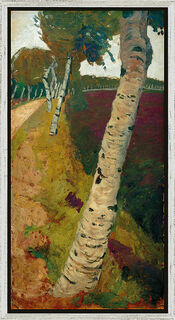
The longer she continued to paint, the further she moved away from the naturalistic style. She looked for the characteristic features in her motifs and broke them down into simplified forms in strong colours. She found inspiration and support for her painting style in the works of artists such as Cézanne, van Gogh, Gauguin, Rousseau and Munch.
Paula Modersohn-Becker Interpreted Pictorial Subjects in an Unusual Way
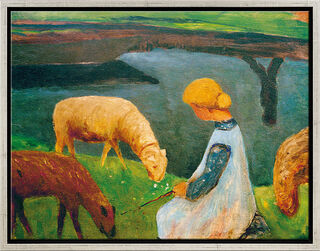
Modersohn-Becker applied her new painting style to all her subjects. She interpreted portraits and landscapes as well as still lifes and self-portraits in a way that was unusual for her time. However, she proved to be progressive not only with her painting style but even with her choice of motifs was also different. For example, she often devoted her portraits to very simple people who otherwise rarely played a role in painting, such as the poor, the elderly, children, mothers, or peasants. She portrayed them very authentically and without embellishing them.
What really broke a taboo, however, was that Modersohn-Becker painted nudes - of both women and men. At the turn of the century, she broke all the rules - especially as a woman. She took it to the extreme when she began to paint nude self-portraits. According to the unanimous opinion of art history, no painter had dared to do this before.

Against All Odds She Pursued Her Life's Dream
The fact that Paula Modersohn-Becker painted nudes and self-nudes is proof of how courageously and uncompromisingly she pursued her own path - both as a woman and as an artist. In doing so, she repeatedly collided with social conventions.
Already as a teenager, she showed great interest in painting, but her parents did not allow any artistic training. Nevertheless, she did not give up her dream of becoming a painter. She would have liked to study at an art academy, but at the end of the 19th century, that was still forbidden for women. So she took courses at various painting schools on her own and in this way acquired a professional artistic education. She increasingly moved away from the traditional maxims of painting and developed her own style. With this style, however, she encountered predominantly rejection.
Scathing Criticism after Group Exhibition in Bremen
When she exhibited her works in a group show in Bremen in 1899, she subsequently had to read a scathing review in the newspaper Weser-Zeitung. Only her husband, Otto Modersohn, initially stood by her and supported her work. But from 1905 onwards, he too became a harsh critic, criticising her concentration on form as well as her primitive manner of depiction. The headwind she had to endure from many directions eventually led her to withdraw from the public eye altogether - but she did not stop painting.
Paula Modersohn-Becker Demonstrated Courage and Consistency in Other Areas of Her Life as Well
Even as a teenager, she had already rejected the idea of being a housewife. When she later travelled to Paris as a married woman without her husband, those around her regarded this with extreme scepticism, if not as "sickening". The fact that she separated completely from Otto Modersohn at times was considered an affront by many. In the end, however, neither the public's lack of interest nor social constraints could prevent Paula Modersohn-Becker from realising both her vision of art and her life concept.

Paula Modersohn-Becker Today: Celebrated Star of Expressionism
Many of her contemporaries considered Paula Modersohn-Becker's paintings to be clearly too progressive. She is said to have sold only three of her works during her lifetime. Today, however, she is celebrated everywhere for her courageous manner and her pioneering work for Expressionism.
Shortly after her death, an increasing number of exhibition houses began to take an interest in her work. In addition, numerous private and public collections included her works in their holdings, including the
- Städel Museum, Frankfurt,
- The Pinakothek der Moderne, Munich,
- The Museum of Modern Art, New York,
- The Metropolitan Museum of Art, New York and
- The British Museum, London.
She also received great posthumous honour in 1927 when the "Paula Modersohn-Becker Museum" opened in Bremen, the world's first exhibition house dedicated to the work of a woman.
Even in the 21st Century, Her Paintings and Drawings Continue to Enjoy Great Popularity
Exhibitions of her works are regularly held in renowned art houses, for example, in 2015 at the "Louisiana Museum of Modern Art" in Humlebæk near Copenhagen, in 2016 at the "Musée d'Art moderne de la Ville de Paris" or in 2021 at the "Schirn Kunsthalle" in Frankfurt am Main.
In 2017, the film "Paula", based on her life story, was shown in cinemas. In addition, the district of Osterholz awards a "Paula Modersohn-Becker Art Prize" every two years. Soon 150 years after her birth, Paula Modersohn-Becker is more present today than ever.
Selected Works by Paula Modersohn-Becker