The Ten Most Famous German Painters: From the Renaissance to the Present Day
Among the artists who have made a significant impact on art history, there are numerous notable painters from Germany. They often carried out pioneering work and had a lasting impact on the painting of their epoch.
However, many famous German painters not only influenced the art of their time. Even though some of them lived many centuries ago, their artistic positions are still considered highly relevant today. Exhibitions featuring works by, for example, Caspar David Friedrich, Emil Nolde, and Gerhard Richter continue to enjoy enduring popularity with the public.
The following section presents ten of the most famous German painters from the Renaissance to the present day. The focus is placed on both their artistic work as well as their biographies and their influence on the course of art history.
Albrecht Dürer - The Famous German Painter of the Renaissance

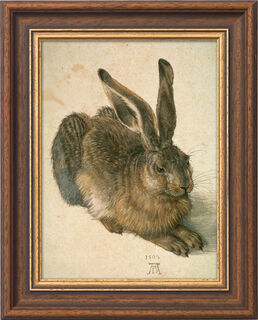
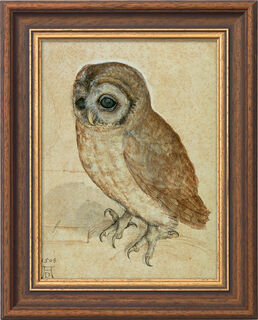
The Renaissance is often primarily perceived as an Italian phenomenon. In this context, names such as Leonardo da Vinci, Michelangelo Buonarroti and Raffael Santi are usually mentioned. However, an important and influential artist of the Renaissance also came from Germany: Albrecht Dürer (1471–1528).
What Makes Dürer's Art So Captivating?
The famous German painter was already highly successful during his lifetime: Above all, he made a name for himself across Europe in the early 16th century, particularly with his printmaking. The special quality of his copperplate engravings and woodcuts lay in their perfection and richness of detail. Dürer always strove to depict his motifs as realistically as possible. He was also able to transfer this naturalistic style of representation to his oil paintings and watercolours.
Master of Self-Portraits and Art Theorist
Albrecht Dürer was also a highly sought-after portrait painter and perfected the genre of self-portraiture. Yet, he was not only one of the most important artists of the Renaissance but also made a name for himself as an art theorist. He wrote numerous writings in which he extensively dealt with the realistic representation of proportions, among other things.
Although Albrecht Dürer was born over 550 years ago, his work is still present in many places today - both in the art world and in everyday culture. His motifs are reproduced countless times and adorn many everyday objects such as porcelain and tableware, bags and umbrellas. In addition, exhibitions exploring various aspects of his work continue to take place regularly.
Caspar David Friedrich - The Great Romantic of German Painting

His name has become synonymous with romantic painting: Caspar David Friedrich (1774-1840). The famous German painter understood better than almost anyone else how to express the philosophy and attitude towards life of his epoch in his pictures.
Many of his works are now icons of art history and known far beyond the borders of Germany, for example:
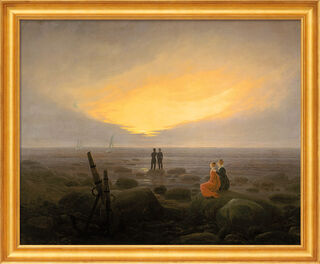
- "Two Men Contemplating the Moon"
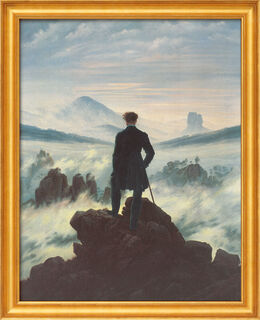
- "Wanderer Above the Sea of Fog"
- "Chalk Cliffs on Rügen"
What Worldview Lies Behind His Work?
From the late 18th century, Romanticism brought about fundamental changes both within society and in art. It followed immediately after the Enlightenment. While this phase was still characterised by very rational, reason-oriented, and progressive thinking, emotions, spirit and soul, as well as religion and mysticism regained importance in Romantic paintings. Caspar David Friedrich directly translated this mindset into his works.
His paintings were to be understood as a kind of symbolic language. He was less concerned with depicting the world realistically in his images. Rather, he evoked strong emotions through the breathtaking atmosphere of his landscape paintings.
What Was Controversial About His Art?
With his atmospheric paintings, Caspar David Friedrich achieved some success even during his lifetime. The famous German painter of Romanticism was able to captivate the public with his detailed and realistic style of depiction. But his works also sparked debates among his contemporaries.
Caspar David Friedrich caused a real scandal in 1808 with his painting "The Cross in the Mountains". He had dared to place a relatively small crucifix in a landscape painting. For many critics, this represented an inappropriate blending of sacred art and landscape painting - an absolute taboo.
Caspar David Friedrich and his art continue to fascinate audiences to this day. His motifs are still omnipresent both in the art world and in everyday culture. Not only are reproductions of his paintings widely available, but many products such as T-shirts, socks, or mugs also feature his motifs. His influence extends into the world of social media. His iconic picture "Wanderer Above the Sea of Fog" has been recreated countless times.
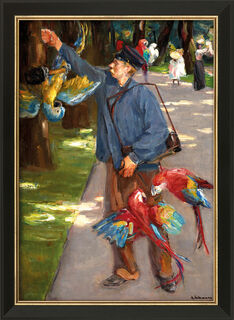
Max Liebermann - Pioneer of German Impressionism

From the mid-19th century onwards, impressionist paintings marked the beginning of a new era in the European art world. French artists such as Claude Monet, Edouard Manet and Camille Pissarro had broken with traditional painting at that time. They no longer sought to create objective representations of the world in their works but rather sought to convey their individual impressions in their pictures. They focused on the atmosphere of the moment, especially the lighting conditions.
In Germany, the painter and graphic artist Max Liebermann (1847-1935) was one of the first and most important representatives of Impressionism. His work from the beginning of the 20th century played a key role in ushering in the dawn of modern painting in Germany.
How Liebermann Broke with Tradition
With his avant-garde artistic philosophy, the famous German painter repeatedly opposed prevailing traditions and conventions throughout his career.
In the years that followed, Liebermann continuously developed his painting style in the direction of Impressionism. At the beginning of the 20th century, he found his individual visual language:
- His works are characterised by their almost tangible atmosphere and masterful play of light and colour.
- His motifs included landscapes such as forests, avenues and gardens, but also urban and street scenes as well as individuals and groups, for example, at the beach or in beer gardens.
Liebermann's Influence in the Art World
Max Liebermann made a name for himself not only as an excellent painter and graphic artist. He was also active in various art institutions. The well-known German painter was president of the Berlin Secession and the Prussian Academy of Arts. He also had the honour of being accepted into the French Société des Beaux-Arts. Alongside Lovis Corinth and Max Slevogt, Max Liebermann is one of the few German impressionists who are still well known today.
Emil Nolde - Magician of Colours

At the beginning of the 20th century, Expressionism brought further changes to the visual arts. Its artists moved even further away from the traditional idea of depicting the world as realistically as possible. Instead, they expressed their emotions, perceptions, ideas, and opinions through their motifs. To do this, they radically changed their visual language. They abandoned natural proportions and colour assignments and reduced the details of the depicted objects - sometimes pushing to the limits of abstraction.
Nolde's Expressionist Imagery
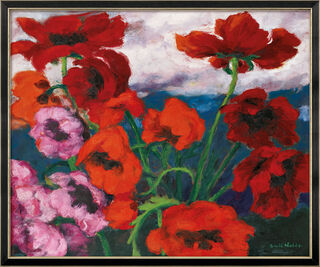
One of the most famous German Expressionist painters was Emil Nolde (1867-1956). He was among the early representatives of this style in Germany. He was a member of both the avant-garde groups the "Berlin Secession" and the "Brücke" group. In 1912, he took part in an exhibition organised by the editorial collective "Blauer Reiter".
Nolde's work includes oil paintings, prints, watercolours and several sculptures. His works continue to fascinate today through their intense colours. It almost seems as if he was guided by colour when choosing and designing his motifs. This is particularly evident in his watercolours - for example, in seascapes such as "Calm Sea with Two Steamers" with its imposing cloud formations. But the famous German painter also brought other motifs to life with his virtuoso colour compositions such as landscapes, flowers, urban scenes, and religious themes.
Nolde and National Socialism
Nolde's qualities as an artist are undisputed, yet his biography has a dark side. The well-known German painter was a supporter of Hitler's politics and a member of the NSDAP. Although he was considered "degenerate" by the National Socialists and was banned from working in 1941, this did not cause him to doubt the Nazi ideology.
After World War II, he made every effort to keep this part of his history out of the public eye and to portray himself as a persecuted artist. He is thus one of several examples in art history where artistic achievement is overshadowed by personal misconduct.
Max Beckmann: Individualist of the Avant-Garde

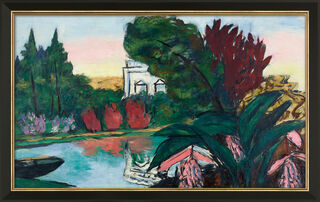
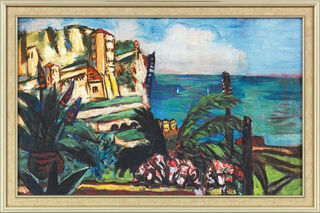
The German painter and graphic artist Max Beckmann (1884-1950) is one of the great exceptional artists of Classical Modernism. Around the turn of the century, painting in Europe underwent a major transformation process. Many avant-garde artists broke with traditional painting and sought contemporary forms of expression. Max Beckmann also reoriented his painting style and drew inspiration from various styles, such as Impressionism, Expressionism, and New Objectivity.
Master of Strong Contrasts and Distorted Perspectives
Beckmann never saw himself as belonging to any one particular epoch but developed his own unique style. However, he always remained true to figurative painting and strictly rejected radical abstraction.
Max Beckmann mastered a particularly impressive visual language:
- The famous German painter always worked with powerful and contrasting colours.
- He often separated the elements of his paintings with black contour lines.
- In his compositions, he frequently played with the proportions of objects.
- He sometimes exaggerated figures to the point of grotesqueness, depicting them with oversized heads or particularly long limbs, for example.
- He also often distorted the pictorial space or manipulated the spatial perspective.
In addition to paintings of individuals, societies, and portraits, he also created cityscapes, architectural views, landscapes, and still lifes, all reflecting in their own way the living conditions at the beginning of the 20th century.
What Makes Max Beckmann’s Life Path So Special?
Max Beckmann had an impressive artistic career. The well-known German painter proved his talent very early:
- He is said to have been only 14 years old when he painted his first self-portrait and first landscape painting.
- From 1900, he attended art school in Weimar and was already exhibiting with the Berlin Secession in 1906.
- From 1914, Beckmann was one of the co-founders of the Free Secession in Berlin.
- He achieved international breakthrough success in the 1920s and was appointed professor at the Städelschule in Frankfurt am Main.
- His career was abruptly interrupted by the policies of the National Socialists. When they labelled him as "degenerate", he left Germany and moved to Amsterdam.
- After World War II, Beckmann emigrated to the United States. There he was able to continue his successful work and took a professorship at the St. Louis School of Fine Arts, among other positions.
- Max Beckmann died in his adopted homeland in December 1950.
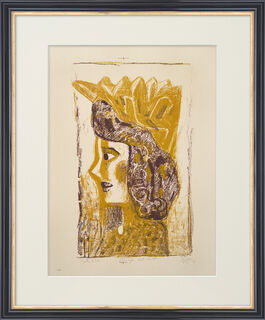
Paul Klee - Key Figure of Modernism

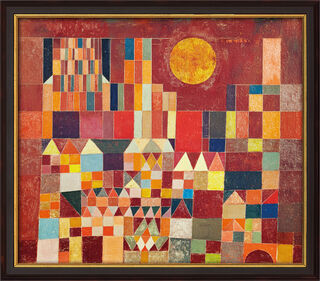
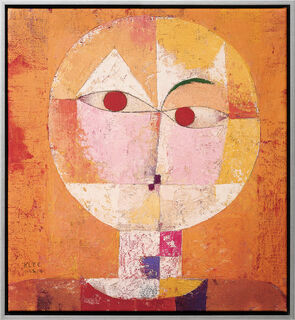
Paul Klee (1879-1940) is one of the most important figures of the European avant-garde of the 20th century. Klee, more than almost any other artist, mastered the effortless transition between figuration and abstraction. He incorporated impulses from various styles such as Expressionism, Constructivism, Cubism, and Surrealism into his work. He also mastered a wide range of themes and moods, ranging from meditative compositions and bizarre, fantastical imagery to motifs imbued with an almost childlike joy.
The Most Important Phases of His Artistic Development
The biography of the German-Swiss painter and graphic artist is closely linked to numerous important phases in art history. Among other things, he took part in an exhibition organised by the editorial collective "Blauer Reiter", which included famous artists such as August Macke, Franz Marc, Gabriele Münter, and Alexej Jawlensky.
Another milestone in Klee's career was his appointment to the Bauhaus in Weimar in 1921. Walter Gropius was one of Klee's great admirers and did everything he could to bring him to the Bauhaus. In a telegram to Klee, he wrote:
"The students are beaming at the thought that you might come; in fact, everyone is waiting for you with love."
Klee taught at the influential art school until 1931. At the same time, in 1924, he founded the exhibition group "Die Blauen Vier" together with Bauhaus masters Lyonel Feininger, Wassily Kandinsky, and Alexej von Jawlensky. In the same year, Klee's first solo exhibition in the United States took place in New York.
Final Years in Exile
As for many progressive artists, the Nazi seizure of power in 1933 marked a turning point for Klee. The Nazis defamed him as "degenerate" and dismissed him from his position as professor at the Düsseldorf Art Academy. Klee subsequently left Germany and emigrated to Switzerland.
Shortly thereafter, he faced another serious challenge. From 1935 on, he suffered (as we know today) from scleroderma, a rheumatic disease. Although it severely impaired him, his creative drive remained unbroken. But in June 1940, he lost the battle against the illness.
Paul Klee's legacy is of inestimable value to art history. The famous German painter created numerous iconic works, including:
- "Senecio"
- "Highway and Byways"
- "Castle and Sun"
His works are represented in all the world's renowned collections, are regularly honoured in exhibitions and are popular and highly priced items at auctions.
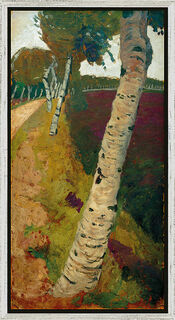
Paula Modersohn-Becker – The Pioneer of Expressionism

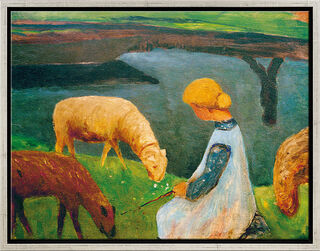
She was an absolute exception in modern art - the German painter Paula Modersohn-Becker (1876–1907). She was not only one of the few women who managed to carve out a place in a male-dominated art world but also played a pioneering role in the development of Expressionism in Germany. In many respects, she was far ahead of her male contemporaries. Modersohn-Becker lived only to the age of 31, but she was an impressive visionary who showed great courage both artistically and personally.
No Place at the Academy - Yet a Pioneer of Modernism
Paula Modersohn-Becker developed an early interest in painting and drawing. She received her first lessons in 1892 during a stay in England. A traditional academic training as a painter, however, was unthinkable at the end of the 19th century. At that time, women were simply not granted access to art academies in Germany. She therefore took private painting lessons and attended various art schools in Paris.
Her stays in the Worpswede artists’ colony also had a major influence on her and helped her develop her individual painting style. Initially, her works still showed clear parallels to Impressionism. But gradually she changed her approach, focusing on just a few essential features of her subjects.
An Unconventional View of Humanity and Reality
She also broke with the conventions of her time in her choice of motifs. In addition to traditional landscapes and still lifes, portraits of people became a major focus in her work. However, for her portraits, she did not choose people of rank or fame. Instead, she focused on ordinary people who otherwise rarely received attention, such as
- the poor,
- the elderly,
- children,
- mothers and
- farmers.
She avoided romanticising or idealising her subjects, portraying them honestly and naturally.
Only Recognised After Her Death
Today, Paula Modersohn-Becker is widely recognised as a pioneering artist. During her lifetime, however, her paintings were considered too progressive for the general public, and she was denied public success. She is said to have sold a maximum of five of her pictures.
The appreciation of her work, however, began to change shortly after her death. Her husband, Otto Modersohn, organised the first exhibitions of her pictures, and collectors also became aware of her work.
Numerous private and public collections have included her works in their holdings, including the Städel Museum, Frankfurt, the Museum of Modern Art, New York, and the British Museum, London.
You can find out more about this extraordinary artist in our article "Paula Modersohn-Becker: An Icon of Classical Modernism".
Otto Dix: Uncompromising Chronicler of His Time

"The painter is the eye of the world", Otto Dix (1891-1969) once said. True to this guiding principle, the German painter and graphic artist made his works into mirrors of contemporary events. With his often-unflinching visual language, he became both an outstanding and controversial artist of his time. Today, he is considered one of the most influential and significant painters of the 20th century.
Plurality of Styles Instead of Conformity
Throughout his career, Otto Dix always followed his own path. He cared little for prevailing artistic trends or conventions. He always chose a form of artistic expression based directly on the subject matter of the picture.
Today, his painting is usually classified under the category of "New Objectivity". However, Dix never felt permanently committed to any single style throughout his career. He ventured into various artistic epochs including Expressionism, Impressionism, Futurism, Dadaism, Realism, and Old Master painting. The most important criterion was that the chosen style had to be able to "show things as they are," as Dix put it.
Uncomfortable Subjects and Political Consequences
He was equally unconventional in his choice of motifs and themes. His works became reflections and commentaries on the events of his time. He addressed the circumstances of World War I and II, the Weimar Republic, National Socialism, and the post-war divided Germany.
His portfolio of motifs was very diverse:
- War scenes
- Cityscapes and landscapes
- Nudes
- Portraits
- Social occasions
- Religious themes
In the diversity of his oeuvre, the individual in times of upheaval always took centre stage. Dix did not shy away from criticising social and political conditions. He often tackled highly uncomfortable, disturbing and provocative topics. Through motifs of human abysses, death, madness, lust and suffering, he repeatedly challenged his audience.
Both his choice of subjects and his grotesque, expressive visual language made him almost inevitably fall out of favour under the Nazis. Like many other avant-garde artists, Dix was defamed as "degenerate". His works were removed from galleries and museums, and he lost his professorship at the Dresden Academy.
Gerhard Richter – The Most Famous German Painter of the Present Day

Gerhard Richter can rightly be called the most famous German painter of the present day. Born in 1932, Richter has been at the forefront of international contemporary art for many decades.
A Leading Figure in Contemporary Art
For 18 consecutive years, the painter, sculptor, and graphic artist has topped the "Kunstkompass" ranking in the German magazine Capital. This makes him the most important contemporary artist, based on exhibitions, museum acquisitions, and awards. His works consistently fetch record-breaking prices at auctions, often in the six- or seven-figure range.
In addition, Gerhard Richter is represented in all relevant collections and art institutions, such as the Centre Pompidou in Paris, the Tate Britain in London, the Museum of Modern Art in New York and the National Museum of Modern Art in Tokyo.
Gerhard Richter's Visual Language
Gerhard Richter has always demonstrated great flexibility in his work in terms of techniques and motifs. While painting forms a central pillar of his work, he also mastered many other techniques such as drawing, printmaking, sculpture, and installation art. He even designed several stained-glass windows for Cologne Cathedral.
He effortlessly alternates between abstraction and figuration. Within Richters extensive body of work, he has developed different focal points. In his figurative paintings, he has made a slight blurriness a signature feature. He subtly dissolves contours and details so that the subjects appear softly unfocused.
German history is also a recurring theme in Richter’s work:
- In 1988, he addressed the Red Army Faction’s terrorism in the series "18 October 1977".
- In 2014, he created the "Birkenau" cycle based on photographs of prisoners at the Auschwitz-Birkenau extermination camp.
Although Gerhard Richter has enjoyed continuous success as an artist, he has never lost touch with reality. He is considered rather shy and reserved and has no need for scandals or provocations. Interviews are rare. Probably the most famous German painter of our time prefers to let his unique works of art speak for themselves.
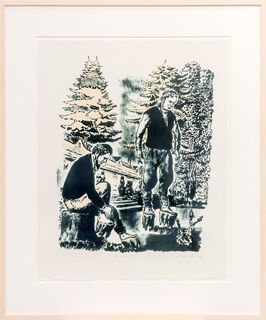
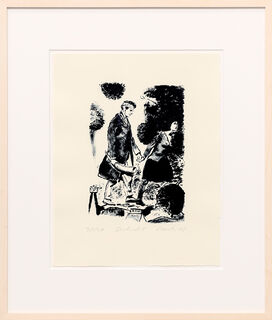
Neo Rauch - Most Important Representative of the "New Leipzig School"

He is the undisputed flagship of the "New Leipzig School" - the painter and graphic artist Neo Rauch. Around the turn of the millennium, a figurative painting style emerged from the "Academy of Visual Arts" in Leipzig, which soon achieved national and international success.
Neo Rauch, born in 1960, is now one of the most important representatives of this school and one of the most significant German painters of the 21st century. But he also represents a generation of artists whose art is shaped by a biography that spans both German states.
Socialist Realism and the Way Out
Rauch's artistic career began during the GDR era. The visual arts in the GDR were largely disconnected from international trends. The state primarily desired and promoted "Socialist Realism" - a figurative, dramatic, and, not least, strongly ideological style of painting.
From 1986 to 1990, Rauch studied under Arno Rink and Bernhard Heisig at the Academy of Visual Arts in Leipzig, where the teaching was still clearly shaped by Socialist Realism. But Rauch was not content to merely continue this style of painting. Instead, he developed an individual and unmistakable figurative visual language, a blend of elements from
- Surrealism,
- Old Master painting,
- Comic aesthetics, and
- Collage.
At first glance, Rauch’s painted scenes appear to tell a real story, almost in the tradition of genre painting. But soon it becomes clear that these motifs are not so easily deciphered. Rather, Rauch constructs surreal situations in his paintings. People who could very well exist in reality encounter fantastical figures and abstract objects against unreal backdrops.
Rauch draws inspiration for his pictorial subjects and scenes from a wide variety of sources:
- Personal experiences and memories from his childhood
- Historical events
- Dream sequences
- Fantasies
- Individual and collective traumas
- Rauch’s protagonists perform actions that seem sensible in themselves but appear absurd or grotesque in the overall context. As a result, Rauch’s often highly complex compositions frequently leave a more confusing impression than a clear message. Yet all his works radiate a powerful aura. Even though their overall mood is often oppressive and at times disturbing, they exert a strong fascination and pull on the viewer.
In Demand Worldwide: The Contemporary Art of Neo Rauch
Neo Rauch has been one of the most famous German painters in the art market for over 30 years. After celebrating his first successes in Germany in the mid-1990s, he managed to gain international recognition from the 2000s onward. His paintings are especially sought after in the United States.
- The renowned German artist has exhibited around the world, including at such prestigious institutions as the Metropolitan Museum of Art in New York, the Museum Frieder Burda, and the Pinakothek der Moderne in Munich.
- His works fetch prices up to seven-figure sums at auctions.
- His work has been honoured with numerous awards, including the Federal Cross of Merit of the Federal Republic of Germany in 2018.
Selected works by the ten most famous German painters